Campus Student App
A student-first mobile experience for accessing academic life with clarity, autonomy, and zero bureaucracy.
Year :
2023
Industry :
Academic - B2C
Client :
Universidad Industrial de Santander
Strategic Challenge
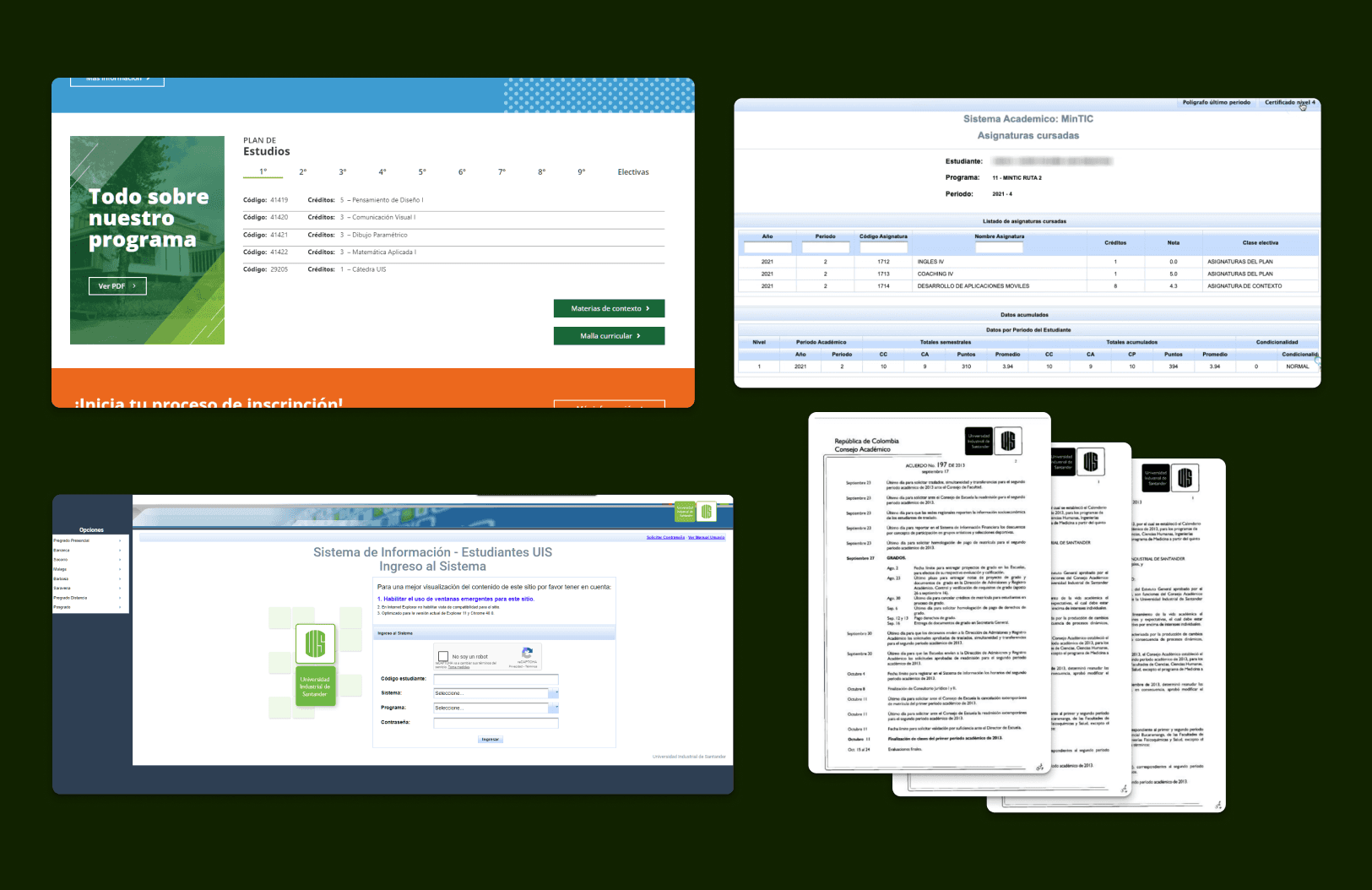
The university’s academic services were technically available, but scattered. Students had to rely on PDFs, public web pages, or desktop portals to access essential tools like schedules, subject searches, academic calendars, or evaluation rubrics.
This created constant friction in everyday tasks: registering for classes, finding buildings, checking deadlines, or understanding course requirements.
Hypothesis: If we centralized high-frequency resources into a single mobile app, students would spend less time navigating bureaucracy and more time navigating their academic paths.
Goal: Build a mobile-first experience that brings together the most used academic tools in a clean, secure, and student-centered platform.
Critical Design Decisions
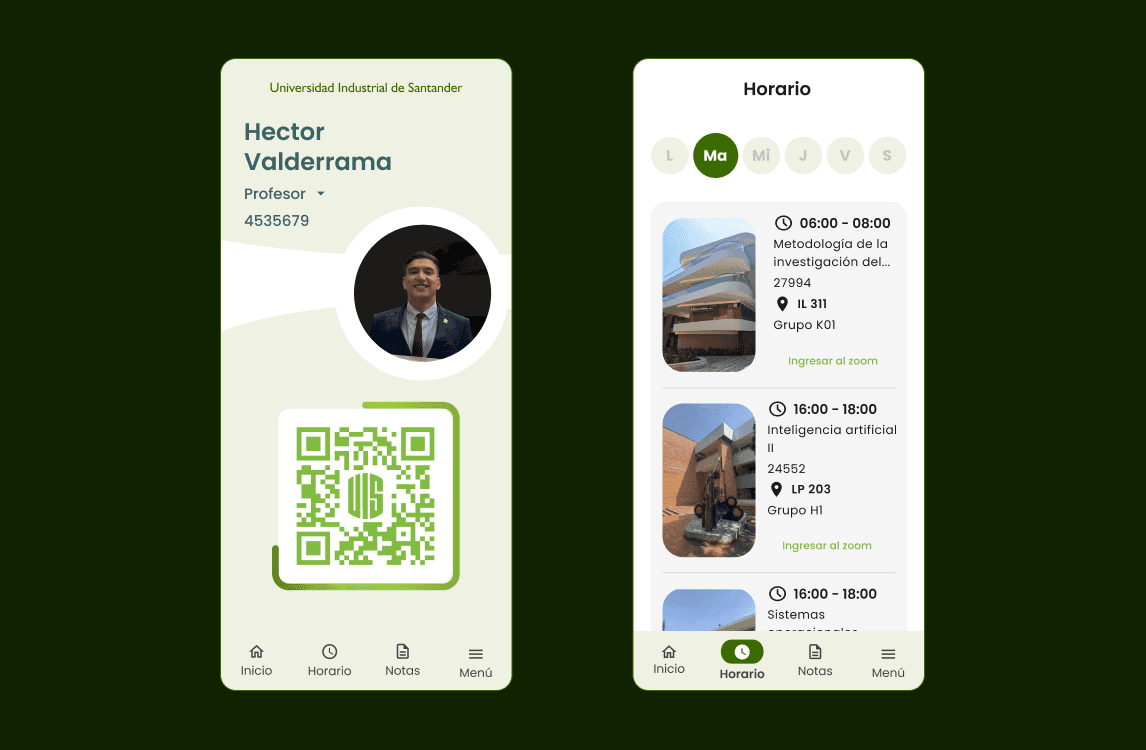
📚 Decision 1 — Centralize the tools students use every single week
We designed the app around real, recurring student needs — not by institutional departments.
What we included:
Class schedules (times, classrooms, locations)
Semester academic calendar (requests, deadlines)
Curriculum plans for every major
Subject search engine to support enrollment decisions
Rationale: These were the most accessed resources but were previously trapped in static PDFs or desktop-only portals.
Impact: Students gained real-time access to everyday academic tools from their phones.
Outcome: Reduced dependency on laptops and dramatically improved access during enrollment and course planning.
🛡️ Decision 2 — Secure campus access through dynamic QR code
We replaced static barcodes and manual ID checks with a rotating QR code, unique to each user and refreshed every 10 seconds.
Rationale: The previous system allowed identity spoofing via printed ID cards or memorized codes.
Impact: Students now enter campus securely without relying on outdated physical credentials.
Outcome: Reduced unauthorized entries and modernized campus security using software instead of staff.
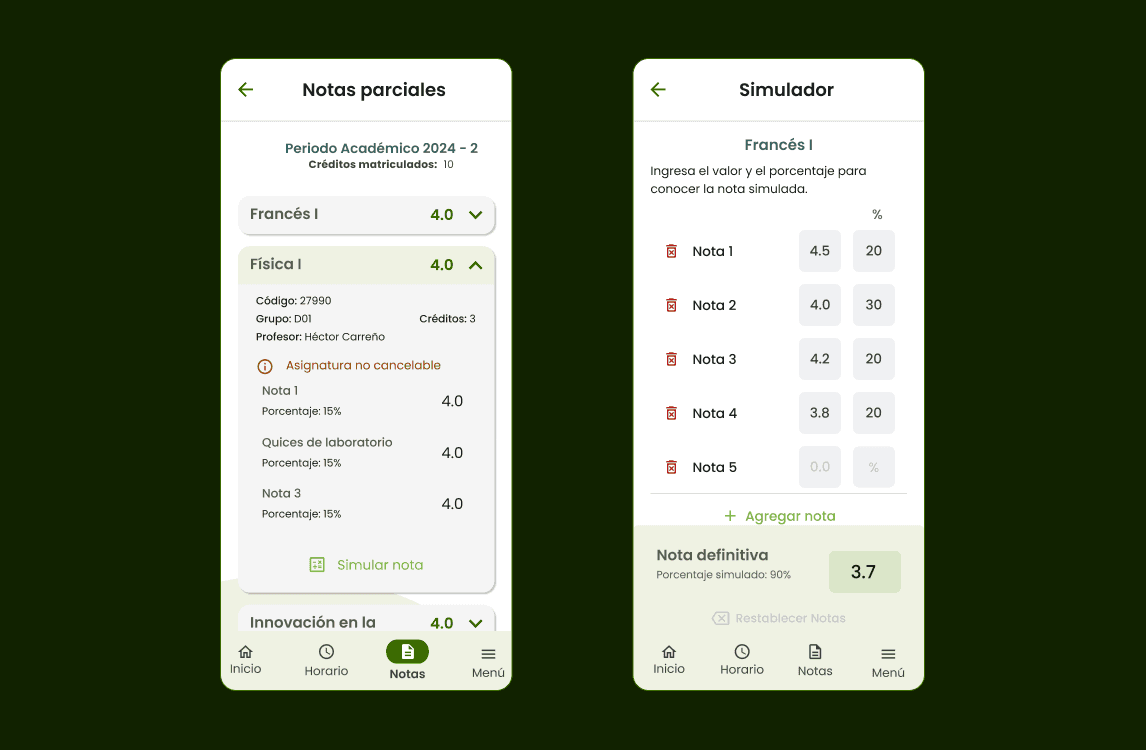
📈 Decision 3 — Help students simulate their academic outcomes
We built a grade simulator tied to each course’s official evaluation rubric.
Rationale: Instead of using calculators and guessing, students input projected scores per assignment to see realistic final grade outcomes.
Impact: Promoted self-awareness and reduced anxiety about academic performance.
Outcome: Students could simulate in 1 minute easily what takes up to 5 minutes before, so it becomes a standard practice to study strategically.
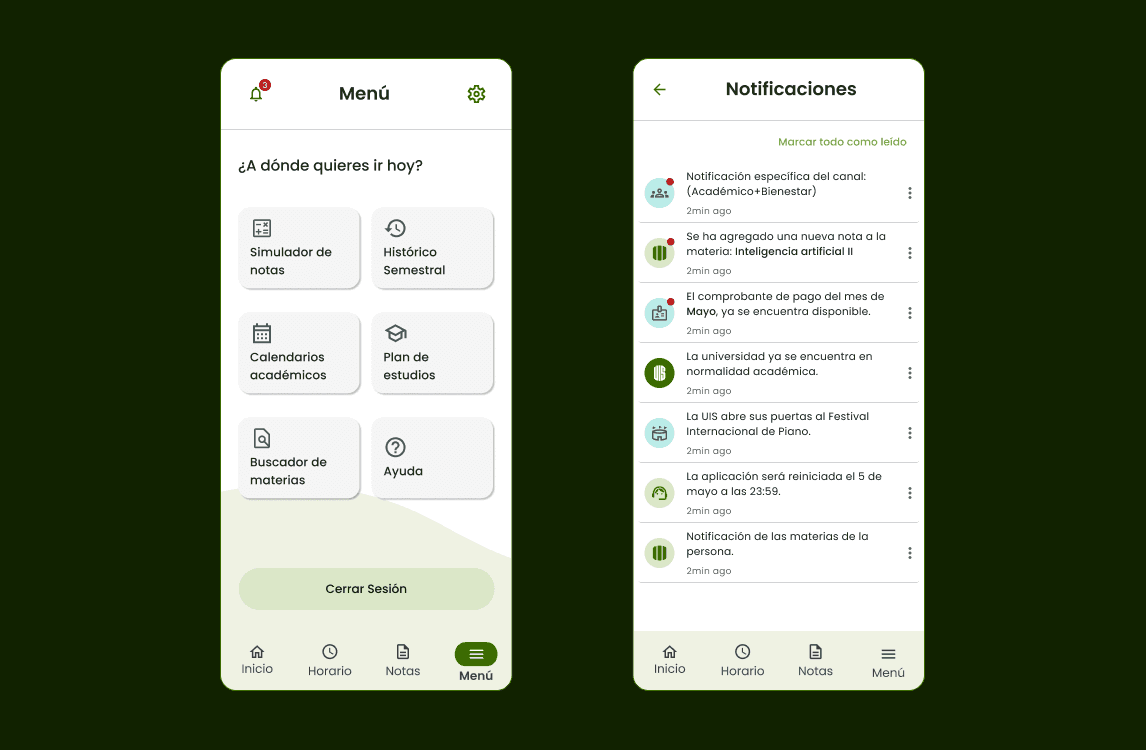
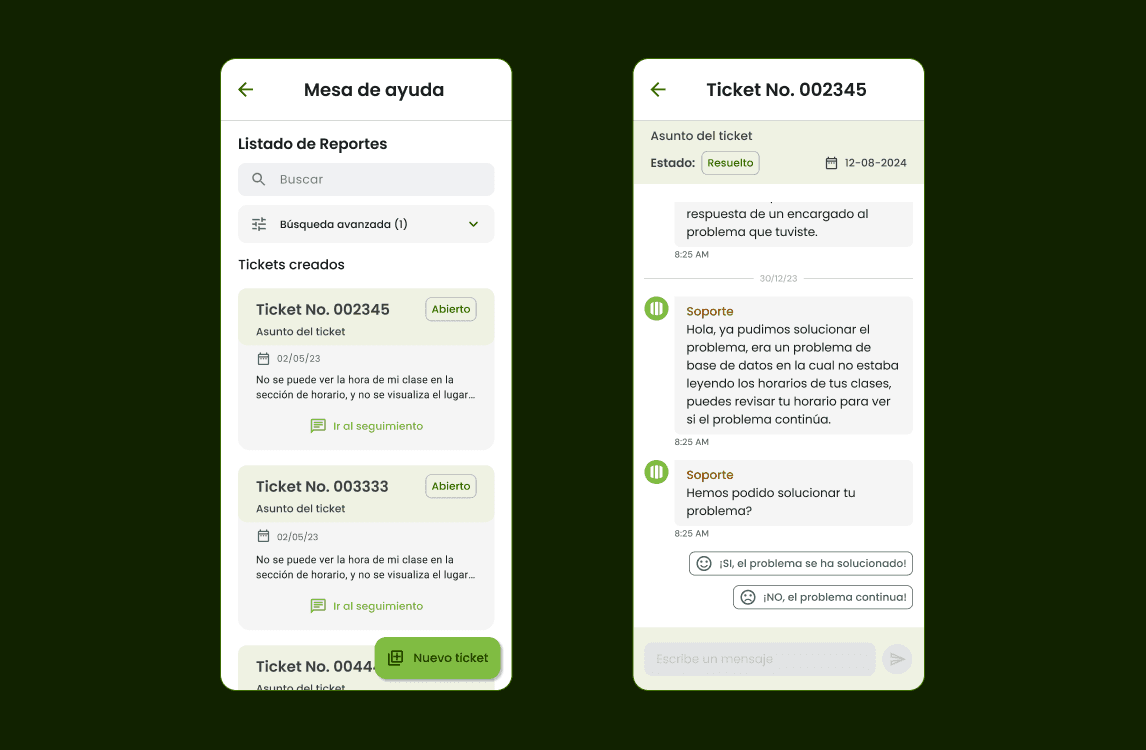
🐞 Decision 4 — Enable in-app reporting directly to the support team
We added a built-in system to report bugs, feedback, or technical issues — directly to the dev/support team.
Rationale: Reporting used to require emails or help desk visits, often ignored or delayed.
Impact: Students can now create tickets instantly and track them from the app.
Outcome: Increased trust in the app’s evolution and reduced friction in issue resolution.
Measurable Results
Area | Observation | Outcome |
|---|---|---|
Resource Access | Centralized high-use tools (schedule, calendar) + Mobile Info. Architecture | Reduced search time by -70% avg. for daily task. |
Campus Security | Dynamic QR with unique refresh logic | Eliminated shared ID access issues, this improved the Campus security Perception by 60% |
Academic Planning | GPA simulator based on real rubrics from systems | Reduced manual GPA simulation time from 5 mins to 1 min time invested |
Feedback Loop | In-app issue reporting with live tracking + Play Store reviews | Higher trust in support. 90% CSAT feedback. 4.7 Play Store Rating |
Learnings
Design clarity beats feature density.
Students needed fewer tools — but better access to the ones that mattered.Digital auths can impact physical environments security.
Develop in-device auth method to entering campus, impacts physical security
“Reporting bugs without bureaucracy made students feel seen.”
Campus Student App
A student-first mobile experience for accessing academic life with clarity, autonomy, and zero bureaucracy.
Year :
2023
Industry :
Academic - B2C
Client :
Universidad Industrial de Santander
Strategic Challenge
The university’s academic services were technically available, but scattered. Students had to rely on PDFs, public web pages, or desktop portals to access essential tools like schedules, subject searches, academic calendars, or evaluation rubrics.
This created constant friction in everyday tasks: registering for classes, finding buildings, checking deadlines, or understanding course requirements.
Hypothesis: If we centralized high-frequency resources into a single mobile app, students would spend less time navigating bureaucracy and more time navigating their academic paths.
Goal: Build a mobile-first experience that brings together the most used academic tools in a clean, secure, and student-centered platform.
Critical Design Decisions
📚 Decision 1 — Centralize the tools students use every single week
We designed the app around real, recurring student needs — not by institutional departments.
What we included:
Class schedules (times, classrooms, locations)
Semester academic calendar (requests, deadlines)
Curriculum plans for every major
Subject search engine to support enrollment decisions
Rationale: These were the most accessed resources but were previously trapped in static PDFs or desktop-only portals.
Impact: Students gained real-time access to everyday academic tools from their phones.
Outcome: Reduced dependency on laptops and dramatically improved access during enrollment and course planning.
🛡️ Decision 2 — Secure campus access through dynamic QR code
We replaced static barcodes and manual ID checks with a rotating QR code, unique to each user and refreshed every 10 seconds.
Rationale: The previous system allowed identity spoofing via printed ID cards or memorized codes.
Impact: Students now enter campus securely without relying on outdated physical credentials.
Outcome: Reduced unauthorized entries and modernized campus security using software instead of staff.
📈 Decision 3 — Help students simulate their academic outcomes
We built a grade simulator tied to each course’s official evaluation rubric.
Rationale: Instead of using calculators and guessing, students input projected scores per assignment to see realistic final grade outcomes.
Impact: Promoted self-awareness and reduced anxiety about academic performance.
Outcome: Students could simulate in 1 minute easily what takes up to 5 minutes before, so it becomes a standard practice to study strategically.
🐞 Decision 4 — Enable in-app reporting directly to the support team
We added a built-in system to report bugs, feedback, or technical issues — directly to the dev/support team.
Rationale: Reporting used to require emails or help desk visits, often ignored or delayed.
Impact: Students can now create tickets instantly and track them from the app.
Outcome: Increased trust in the app’s evolution and reduced friction in issue resolution.
Measurable Results
Area | Observation | Outcome |
|---|---|---|
Resource Access | Centralized high-use tools (schedule, calendar) + Mobile Info. Architecture | Reduced search time by -70% avg. for daily task. |
Campus Security | Dynamic QR with unique refresh logic | Eliminated shared ID access issues, this improved the Campus security Perception by 60% |
Academic Planning | GPA simulator based on real rubrics from systems | Reduced manual GPA simulation time from 5 mins to 1 min time invested |
Feedback Loop | In-app issue reporting with live tracking + Play Store reviews | Higher trust in support. 90% CSAT feedback. 4.7 Play Store Rating |
Learnings
Design clarity beats feature density.
Students needed fewer tools — but better access to the ones that mattered.Digital auths can impact physical environments security.
Develop in-device auth method to entering campus, impacts physical security
“Reporting bugs without bureaucracy made students feel seen.”
Campus Student App
A student-first mobile experience for accessing academic life with clarity, autonomy, and zero bureaucracy.
Year :
2023
Industry :
Academic - B2C
Client :
Universidad Industrial de Santander
Strategic Challenge
The university’s academic services were technically available, but scattered. Students had to rely on PDFs, public web pages, or desktop portals to access essential tools like schedules, subject searches, academic calendars, or evaluation rubrics.
This created constant friction in everyday tasks: registering for classes, finding buildings, checking deadlines, or understanding course requirements.
Hypothesis: If we centralized high-frequency resources into a single mobile app, students would spend less time navigating bureaucracy and more time navigating their academic paths.
Goal: Build a mobile-first experience that brings together the most used academic tools in a clean, secure, and student-centered platform.
Critical Design Decisions
📚 Decision 1 — Centralize the tools students use every single week
We designed the app around real, recurring student needs — not by institutional departments.
What we included:
Class schedules (times, classrooms, locations)
Semester academic calendar (requests, deadlines)
Curriculum plans for every major
Subject search engine to support enrollment decisions
Rationale: These were the most accessed resources but were previously trapped in static PDFs or desktop-only portals.
Impact: Students gained real-time access to everyday academic tools from their phones.
Outcome: Reduced dependency on laptops and dramatically improved access during enrollment and course planning.
🛡️ Decision 2 — Secure campus access through dynamic QR code
We replaced static barcodes and manual ID checks with a rotating QR code, unique to each user and refreshed every 10 seconds.
Rationale: The previous system allowed identity spoofing via printed ID cards or memorized codes.
Impact: Students now enter campus securely without relying on outdated physical credentials.
Outcome: Reduced unauthorized entries and modernized campus security using software instead of staff.
📈 Decision 3 — Help students simulate their academic outcomes
We built a grade simulator tied to each course’s official evaluation rubric.
Rationale: Instead of using calculators and guessing, students input projected scores per assignment to see realistic final grade outcomes.
Impact: Promoted self-awareness and reduced anxiety about academic performance.
Outcome: Students could simulate in 1 minute easily what takes up to 5 minutes before, so it becomes a standard practice to study strategically.
🐞 Decision 4 — Enable in-app reporting directly to the support team
We added a built-in system to report bugs, feedback, or technical issues — directly to the dev/support team.
Rationale: Reporting used to require emails or help desk visits, often ignored or delayed.
Impact: Students can now create tickets instantly and track them from the app.
Outcome: Increased trust in the app’s evolution and reduced friction in issue resolution.
Measurable Results
Area | Observation | Outcome |
|---|---|---|
Resource Access | Centralized high-use tools (schedule, calendar) + Mobile Info. Architecture | Reduced search time by -70% avg. for daily task. |
Campus Security | Dynamic QR with unique refresh logic | Eliminated shared ID access issues, this improved the Campus security Perception by 60% |
Academic Planning | GPA simulator based on real rubrics from systems | Reduced manual GPA simulation time from 5 mins to 1 min time invested |
Feedback Loop | In-app issue reporting with live tracking + Play Store reviews | Higher trust in support. 90% CSAT feedback. 4.7 Play Store Rating |
Learnings
Design clarity beats feature density.
Students needed fewer tools — but better access to the ones that mattered.Digital auths can impact physical environments security.
Develop in-device auth method to entering campus, impacts physical security
“Reporting bugs without bureaucracy made students feel seen.”