Multi-Layer Cybersecurity Alert System
Fleet Defender is a telematics-driven platform that helps fleet operators detect, investigate, and resolve vehicle security incidents in real time across thousands of trucks and trailers.
Year :
Since 2025
Industry :
Cybersecurity Logistics - B2B
Client :
Fleet Defender
Strategic Challenge
Fleet telematics platforms generate massive volumes of operational signals—from GPS telemetry to device connectivity events—yet most logistics software still relies heavily on historical reports rather than real-time decision systems.
For fleet security teams, this creates a critical gap: incidents such as unauthorized device connections or theft anomalies require immediate investigation and response, not delayed reporting.
Fleet Defender needed to transform fragmented telematics signals into a system that could help operators detect incidents quickly, investigate their causes, and resolve them through structured workflows.
Design hypothesis:
If telematics signals could be structured into a layered operational interface—progressively revealing context and resolution tools—fleet managers could move from detection to incident resolution significantly faster.
Note: Some details and interface elements have been simplified or anonymized to protect sensitive product and customer data.
Critical Design Decisions
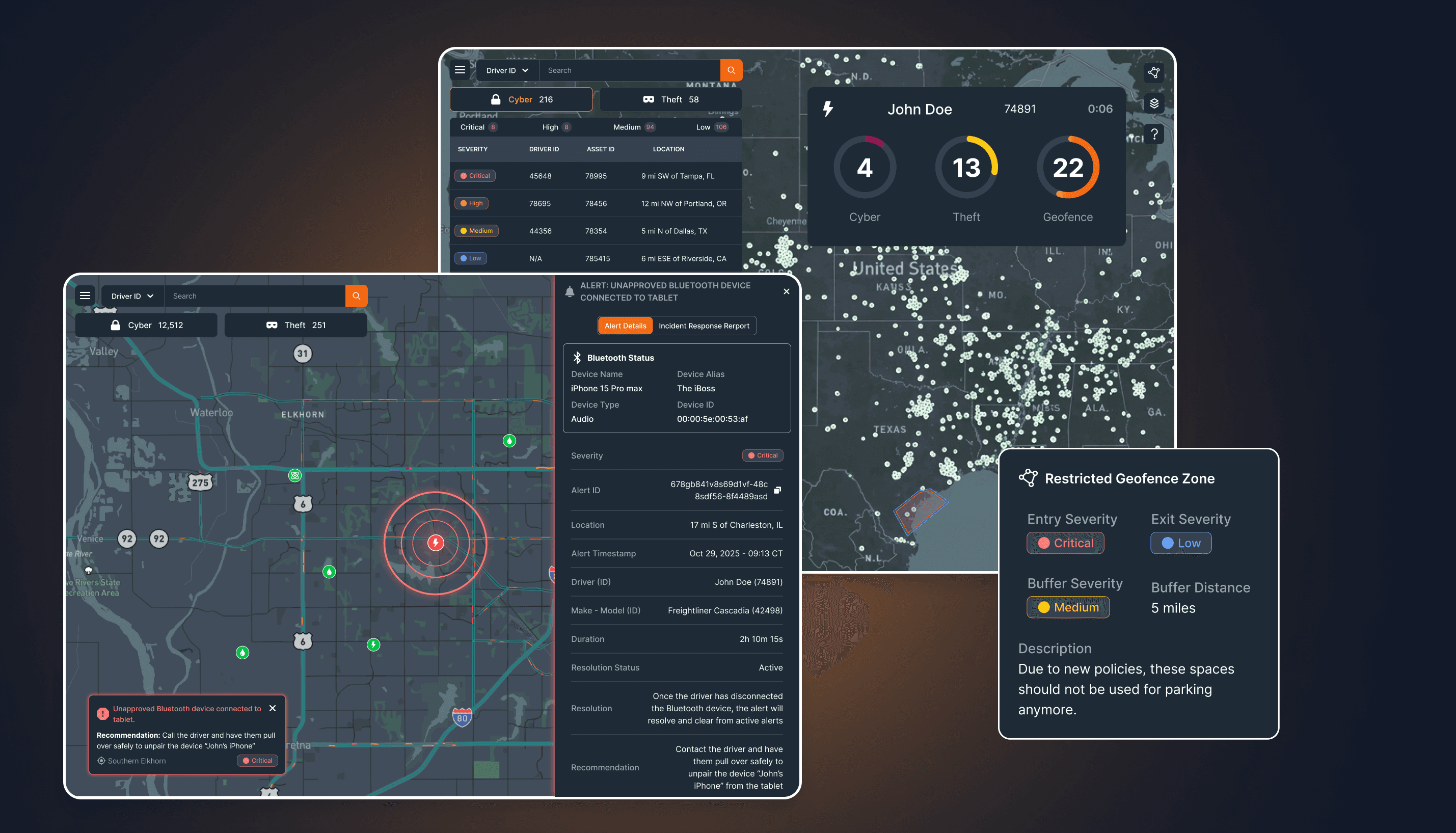
Decision 1 — Multi-Layer Progressive Disclosure
Instead of overwhelming users with data, the interface reveals information in layers:
Map → Hover Card → Side Drawer → Incident Response.
This structure allows operators to move quickly from detection to investigation while maintaining system context.
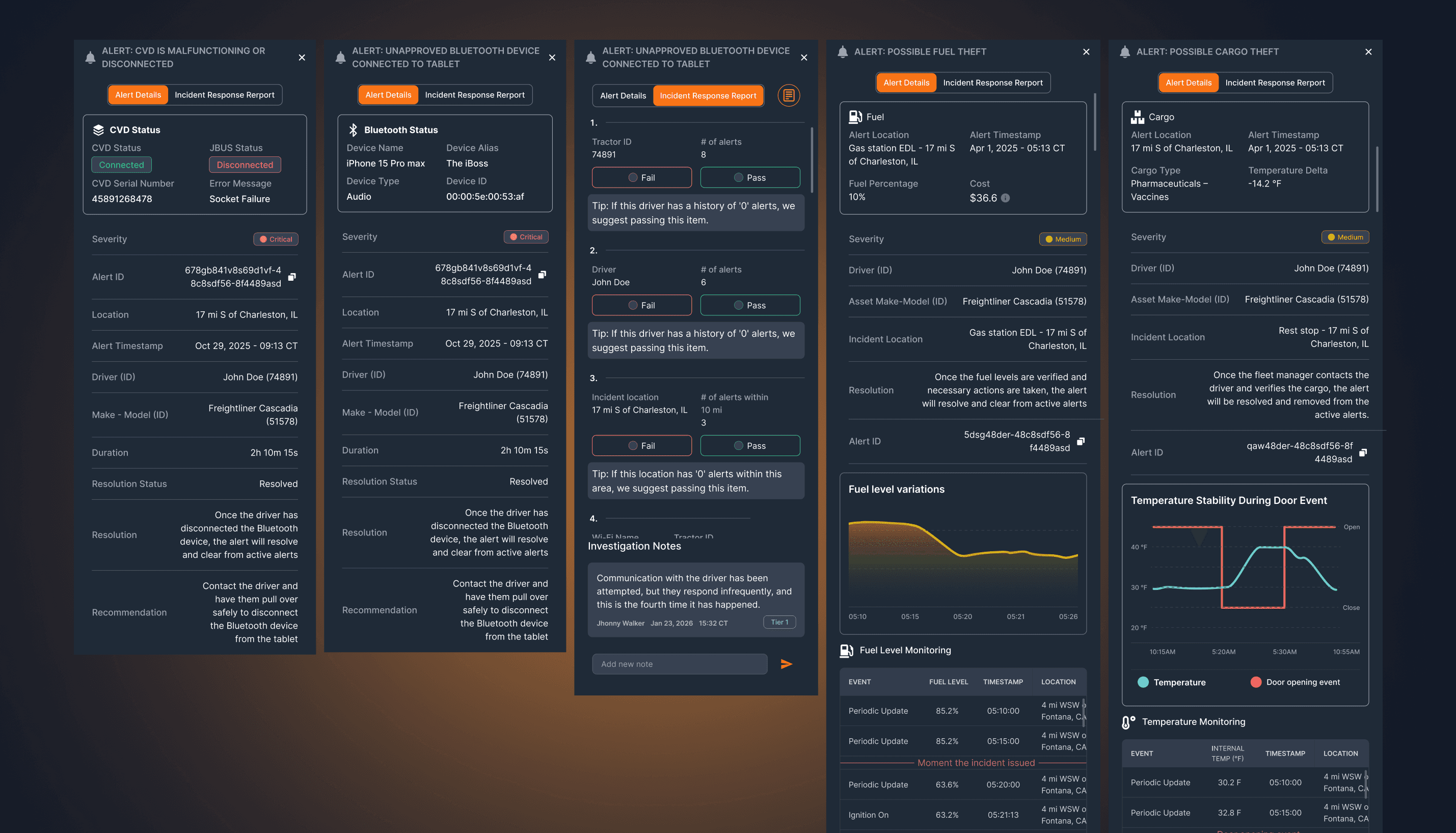
Decision 2 — Side Drawer Investigation Pattern
Incident details open in a side drawer rather than a new page.
This allows users to investigate multiple alerts sequentially without losing spatial context from the map or dashboard.
The pattern became a system-wide interaction standard used across monitoring and analytics modules.
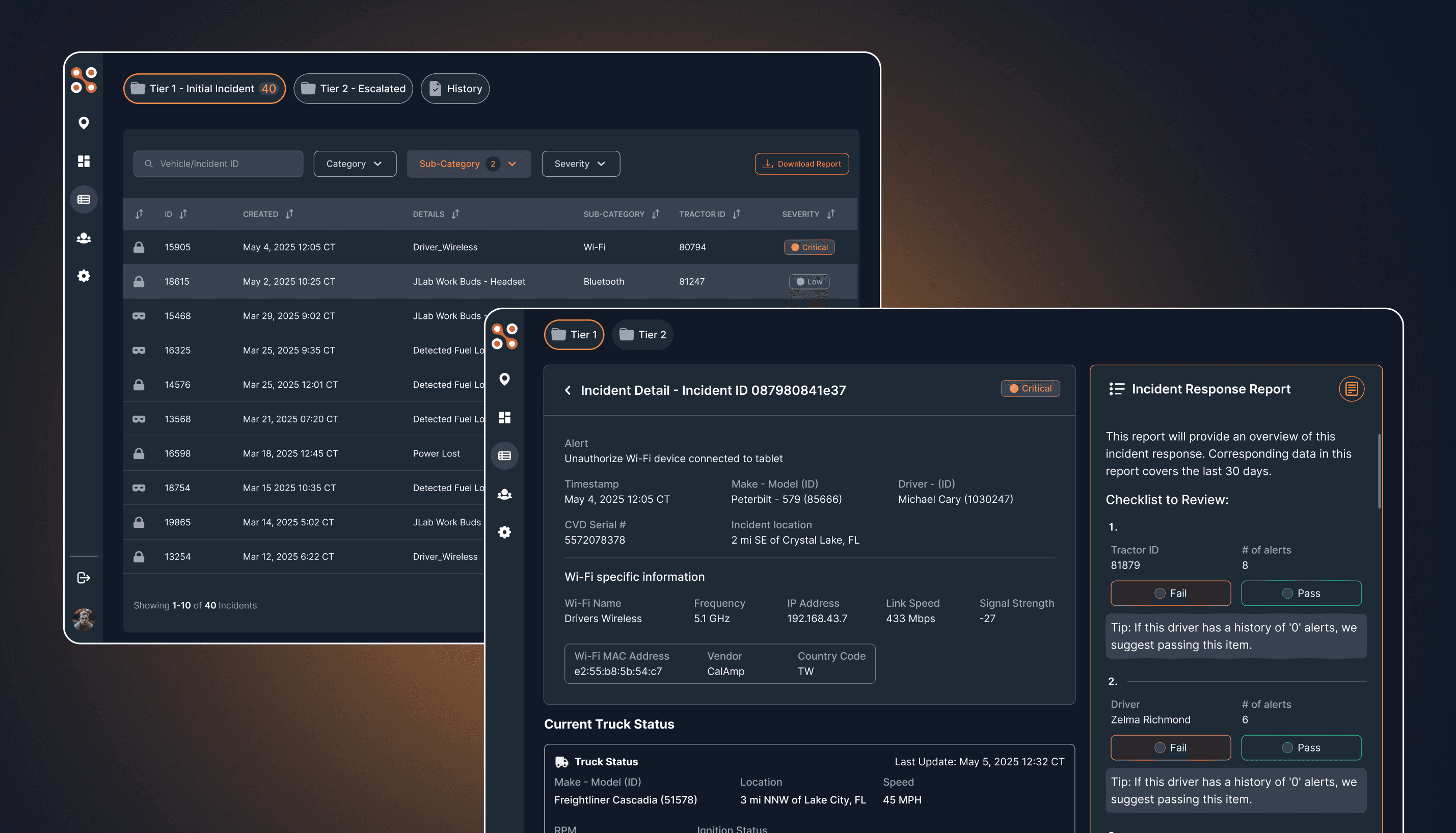
Decision 3 — Integrated Incident Response Workflow
Alerts are not treated as isolated signals.
Each alert can transition into a structured incident response process, including:
device verification
signal analysis
investigation notes
escalation tiers
resolution reports
This transforms the system from monitoring software into operational response infrastructure.
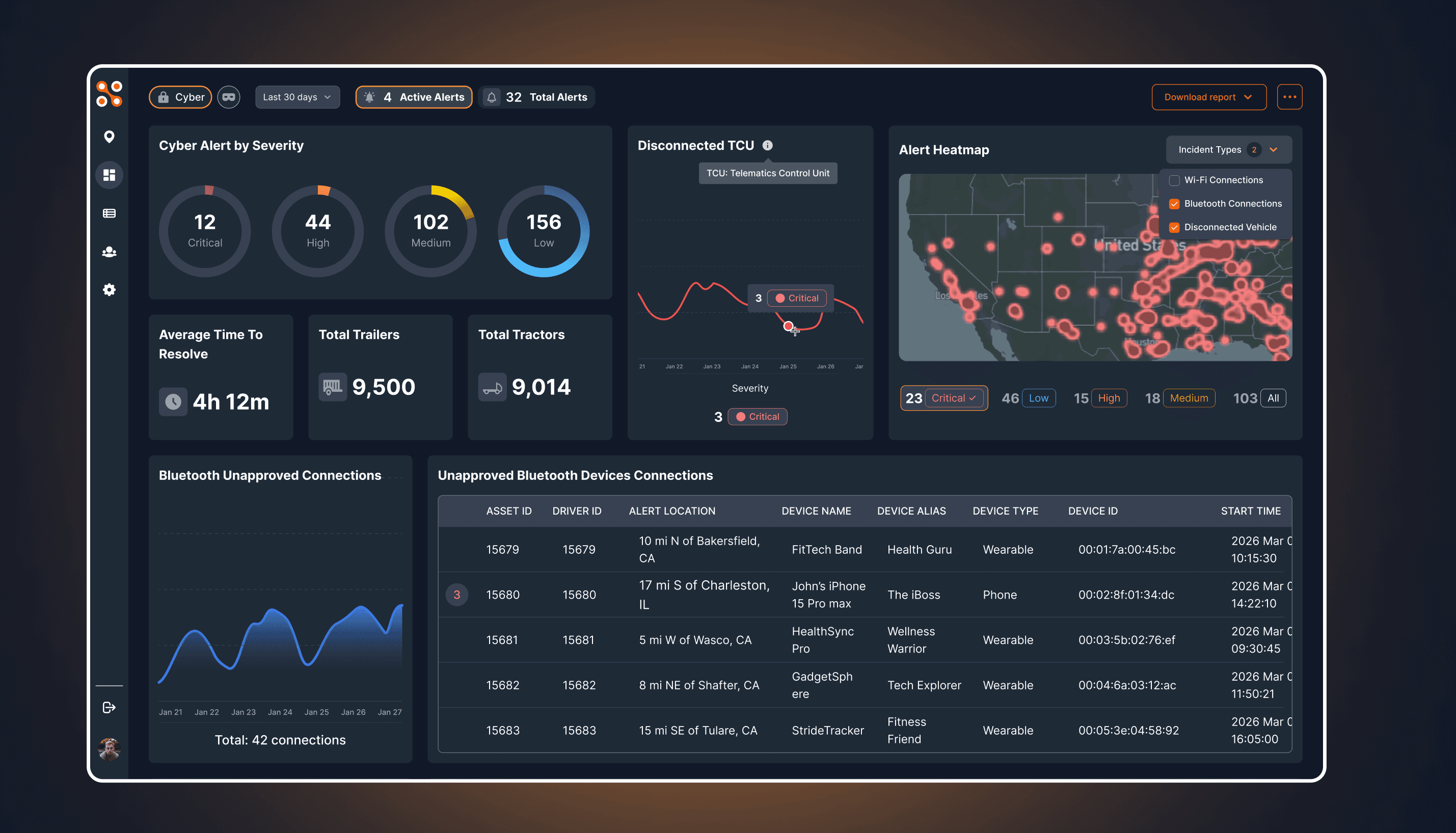
Decision 4 — Operational Pattern Detection Dashboard
Security incidents rarely occur in isolation; they often emerge from recurring behavioral patterns across fleets. I designed a cyber analytics dashboard that aggregates alert trends across time, vehicles, and connection events.
The dashboard includes:
Alert severity distribution
Time-to-resolution metrics
Connection anomaly trends
Geographic heatmaps of incidents
Measurable Results Table
Area | Improvement | Outcome |
|---|---|---|
Operational Context Switching | Investigation tools consolidated into a single interface | Reduced tool switching from 3 to 1 during incident analysis |
Incident Investigation | Contextual side drawer showing device, driver, vehicle, and connection metadata | Reduced investigation time from 8 minutes to ~2 minutes per incident |
Incident Response Workflow | Structured response panel with verification checklist and historical data | Reduced incident resolution time from 20 minutes to ~8 minutes |
Design Trade-offs
1. Real-time density vs visual simplicity
High information density was required to support investigations, requiring careful layering to avoid cognitive overload.
Drawer-based investigation vs full-page views
Side drawers preserved context but required careful layout design to maintain readability for dense datasets.
Multi-provider telematics data normalization
Different telematics providers produced inconsistent data structures, requiring simplify data design and layouts to provide an scalable cross-functional experience
Learnings
Operational software should prioritize decision speed over visual simplicity.
Progressive disclosure is critical when designing interfaces for high-density data systems.
Alerts alone are not valuable unless they connect directly to a structured response workflow.
🔗 Explore the Full Project
🌐 Product Website Link
🚀Schedule a Demo for your company Link
💼 Designed by Hermes López Alba
Multi-Layer Cybersecurity Alert System
Fleet Defender is a telematics-driven platform that helps fleet operators detect, investigate, and resolve vehicle security incidents in real time across thousands of trucks and trailers.
Year :
Since 2025
Industry :
Cybersecurity Logistics - B2B
Client :
Fleet Defender
Strategic Challenge
Fleet telematics platforms generate massive volumes of operational signals—from GPS telemetry to device connectivity events—yet most logistics software still relies heavily on historical reports rather than real-time decision systems.
For fleet security teams, this creates a critical gap: incidents such as unauthorized device connections or theft anomalies require immediate investigation and response, not delayed reporting.
Fleet Defender needed to transform fragmented telematics signals into a system that could help operators detect incidents quickly, investigate their causes, and resolve them through structured workflows.
Design hypothesis:
If telematics signals could be structured into a layered operational interface—progressively revealing context and resolution tools—fleet managers could move from detection to incident resolution significantly faster.
Note: Some details and interface elements have been simplified or anonymized to protect sensitive product and customer data.
Critical Design Decisions
Decision 1 — Multi-Layer Progressive Disclosure
Instead of overwhelming users with data, the interface reveals information in layers:
Map → Hover Card → Side Drawer → Incident Response.
This structure allows operators to move quickly from detection to investigation while maintaining system context.
Decision 2 — Side Drawer Investigation Pattern
Incident details open in a side drawer rather than a new page.
This allows users to investigate multiple alerts sequentially without losing spatial context from the map or dashboard.
The pattern became a system-wide interaction standard used across monitoring and analytics modules.
Decision 3 — Integrated Incident Response Workflow
Alerts are not treated as isolated signals.
Each alert can transition into a structured incident response process, including:
device verification
signal analysis
investigation notes
escalation tiers
resolution reports
This transforms the system from monitoring software into operational response infrastructure.
Decision 4 — Operational Pattern Detection Dashboard
Security incidents rarely occur in isolation; they often emerge from recurring behavioral patterns across fleets. I designed a cyber analytics dashboard that aggregates alert trends across time, vehicles, and connection events.
The dashboard includes:
Alert severity distribution
Time-to-resolution metrics
Connection anomaly trends
Geographic heatmaps of incidents
Measurable Results Table
Area | Improvement | Outcome |
|---|---|---|
Operational Context Switching | Investigation tools consolidated into a single interface | Reduced tool switching from 3 to 1 during incident analysis |
Incident Investigation | Contextual side drawer showing device, driver, vehicle, and connection metadata | Reduced investigation time from 8 minutes to ~2 minutes per incident |
Incident Response Workflow | Structured response panel with verification checklist and historical data | Reduced incident resolution time from 20 minutes to ~8 minutes |
Design Trade-offs
1. Real-time density vs visual simplicity
High information density was required to support investigations, requiring careful layering to avoid cognitive overload.
Drawer-based investigation vs full-page views
Side drawers preserved context but required careful layout design to maintain readability for dense datasets.
Multi-provider telematics data normalization
Different telematics providers produced inconsistent data structures, requiring simplify data design and layouts to provide an scalable cross-functional experience
Learnings
Operational software should prioritize decision speed over visual simplicity.
Progressive disclosure is critical when designing interfaces for high-density data systems.
Alerts alone are not valuable unless they connect directly to a structured response workflow.
🔗 Explore the Full Project
🌐 Product Website Link
🚀Schedule a Demo for your company Link
💼 Designed by Hermes López Alba
Multi-Layer Cybersecurity Alert System
Fleet Defender is a telematics-driven platform that helps fleet operators detect, investigate, and resolve vehicle security incidents in real time across thousands of trucks and trailers.
Year :
Since 2025
Industry :
Cybersecurity Logistics - B2B
Client :
Fleet Defender
Strategic Challenge
Fleet telematics platforms generate massive volumes of operational signals—from GPS telemetry to device connectivity events—yet most logistics software still relies heavily on historical reports rather than real-time decision systems.
For fleet security teams, this creates a critical gap: incidents such as unauthorized device connections or theft anomalies require immediate investigation and response, not delayed reporting.
Fleet Defender needed to transform fragmented telematics signals into a system that could help operators detect incidents quickly, investigate their causes, and resolve them through structured workflows.
Design hypothesis:
If telematics signals could be structured into a layered operational interface—progressively revealing context and resolution tools—fleet managers could move from detection to incident resolution significantly faster.
Note: Some details and interface elements have been simplified or anonymized to protect sensitive product and customer data.
Critical Design Decisions
Decision 1 — Multi-Layer Progressive Disclosure
Instead of overwhelming users with data, the interface reveals information in layers:
Map → Hover Card → Side Drawer → Incident Response.
This structure allows operators to move quickly from detection to investigation while maintaining system context.
Decision 2 — Side Drawer Investigation Pattern
Incident details open in a side drawer rather than a new page.
This allows users to investigate multiple alerts sequentially without losing spatial context from the map or dashboard.
The pattern became a system-wide interaction standard used across monitoring and analytics modules.
Decision 3 — Integrated Incident Response Workflow
Alerts are not treated as isolated signals.
Each alert can transition into a structured incident response process, including:
device verification
signal analysis
investigation notes
escalation tiers
resolution reports
This transforms the system from monitoring software into operational response infrastructure.
Decision 4 — Operational Pattern Detection Dashboard
Security incidents rarely occur in isolation; they often emerge from recurring behavioral patterns across fleets. I designed a cyber analytics dashboard that aggregates alert trends across time, vehicles, and connection events.
The dashboard includes:
Alert severity distribution
Time-to-resolution metrics
Connection anomaly trends
Geographic heatmaps of incidents
Measurable Results Table
Area | Improvement | Outcome |
|---|---|---|
Operational Context Switching | Investigation tools consolidated into a single interface | Reduced tool switching from 3 to 1 during incident analysis |
Incident Investigation | Contextual side drawer showing device, driver, vehicle, and connection metadata | Reduced investigation time from 8 minutes to ~2 minutes per incident |
Incident Response Workflow | Structured response panel with verification checklist and historical data | Reduced incident resolution time from 20 minutes to ~8 minutes |
Design Trade-offs
1. Real-time density vs visual simplicity
High information density was required to support investigations, requiring careful layering to avoid cognitive overload.
Drawer-based investigation vs full-page views
Side drawers preserved context but required careful layout design to maintain readability for dense datasets.
Multi-provider telematics data normalization
Different telematics providers produced inconsistent data structures, requiring simplify data design and layouts to provide an scalable cross-functional experience
Learnings
Operational software should prioritize decision speed over visual simplicity.
Progressive disclosure is critical when designing interfaces for high-density data systems.
Alerts alone are not valuable unless they connect directly to a structured response workflow.
🔗 Explore the Full Project
🌐 Product Website Link
🚀Schedule a Demo for your company Link
💼 Designed by Hermes López Alba