Mercado Pago POS Experience
Introducing card payments to small merchants in Colombia through UX strategy, research, and interface design.
Year :
2024
Industry :
Fintech – B2B Payments
Client :
Mercado Pago
Strategic Challenge
While Mercado Pago is well known across LATAM, its physical POS (Point of Sale) reader had low awareness and adoption in Colombia, especially among small business owners who rely heavily on cash and informal payment methods.
The challenge wasn’t to “design a screen,” but to design trust.
Hypothesis: By researching the specific hesitations and behaviors of Colombian merchants, we could design an experience that feels accessible, intuitive, and relevant to users unfamiliar with digital POS tools.
Goal: Redesign the payment flow and promotional landing page for Mercado Pago’s POS reader with localized UX strategy and real user insights.

Critical Design Decisions
🔍 Decision 1 — Research local adoption barriers through interviews
I conducted interviews with 12 microbusiness owners across sectors like fashion, retail, and services.
Rationale: Colombia has unique tech-cultural gaps around payment tech, often based on mistrust and misinformation.
Insight: 58% had never used a POS system, mostly due to perceived complexity or cost.
Outcome: Defined a new persona ("Clara", a 51-year-old seamstress) whose emotional resistance shaped all UX decisions.
📊 Decision 2 — Map emotional & technical friction in the payment flow
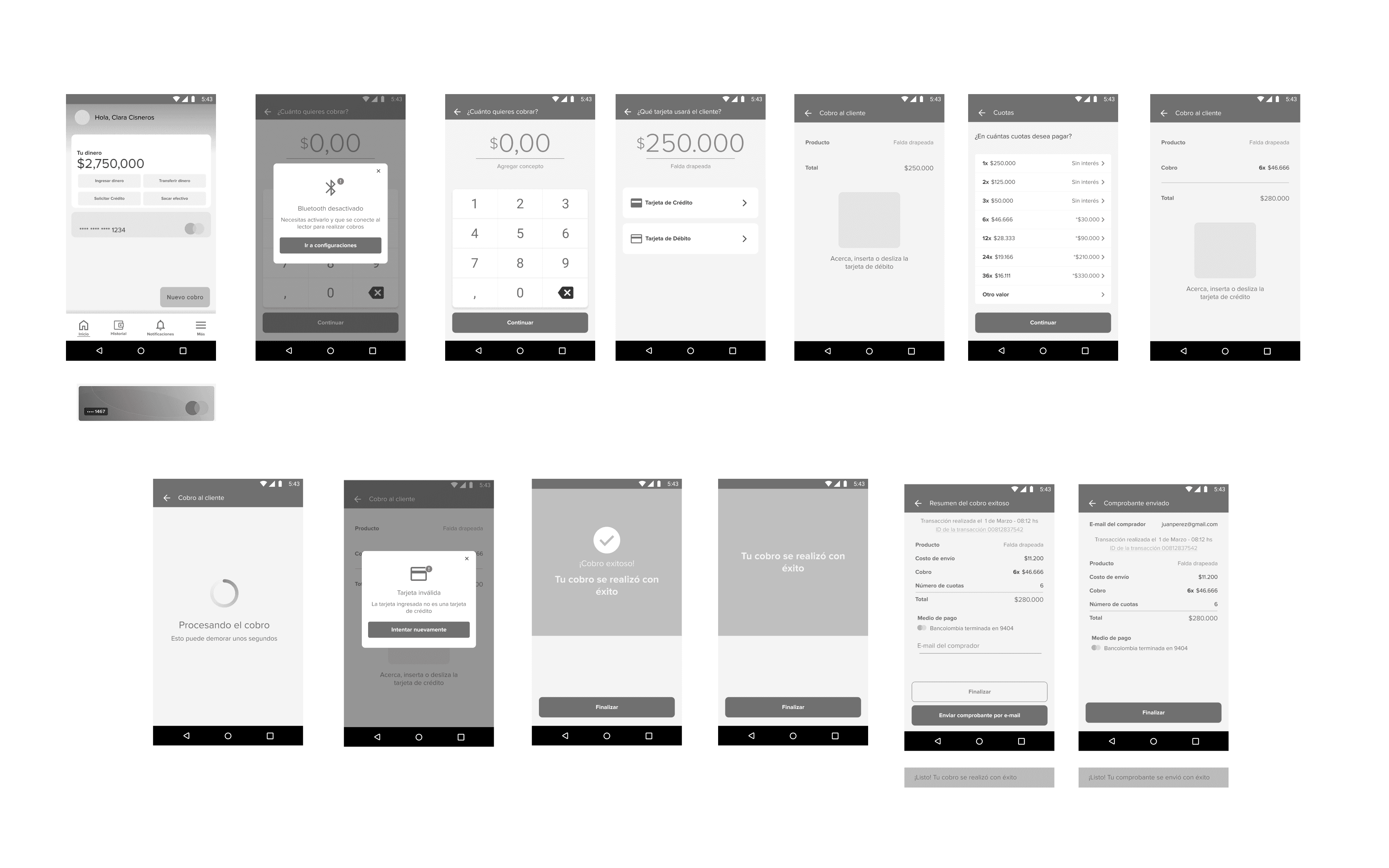
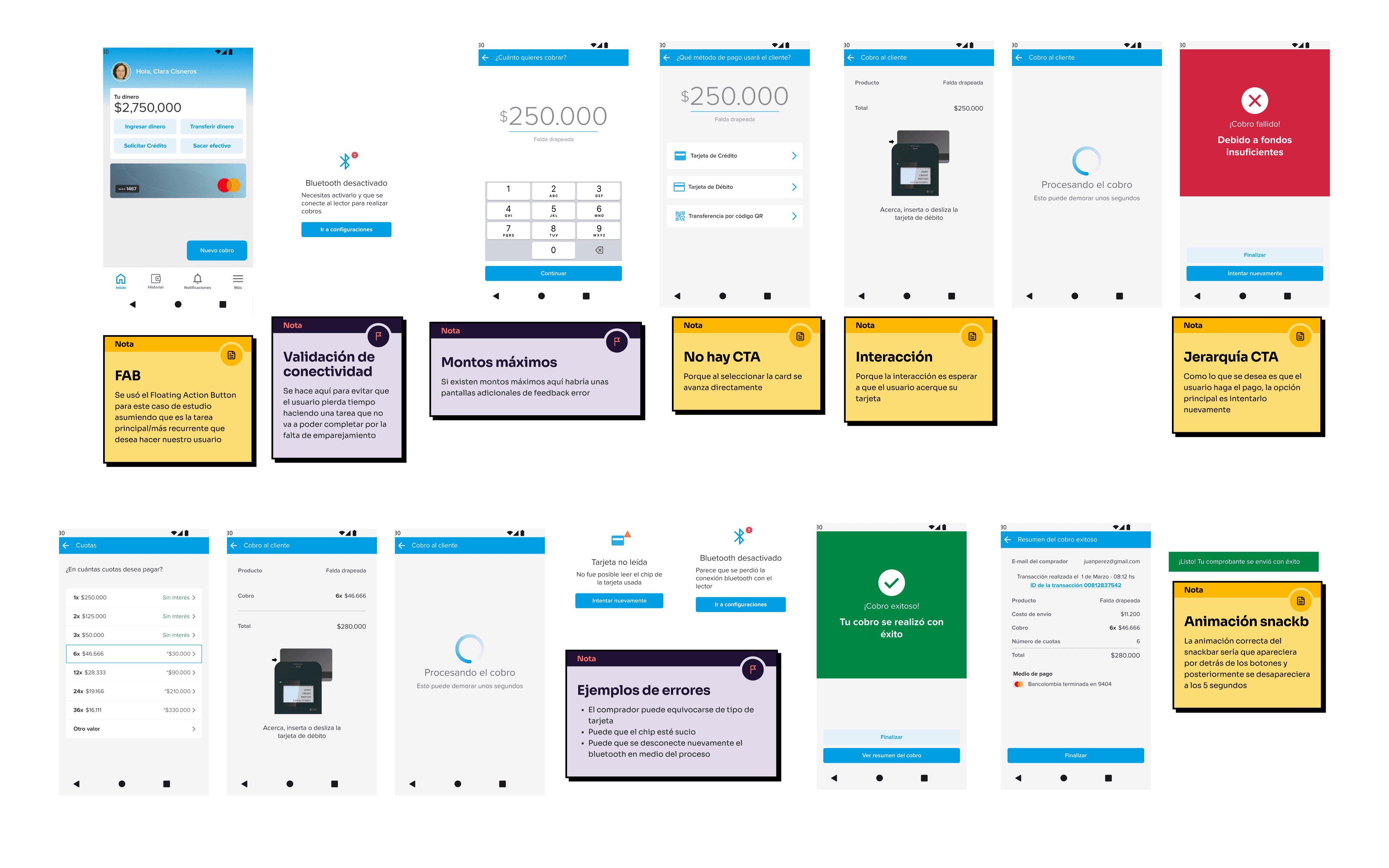
Mapped a complete POS flow including both "happy paths" and friction points like failed Bluetooth connection, chip errors, or incorrect card type.
Rationale: In low-trust environments, clarity and feedback are more important than visual polish.
Impact: Added microinteractions and snackbars that confirm state changes and errors clearly.
Outcome: Reduced decision anxiety by surfacing clear steps and fallback options.
🎨 Decision 3 — Adapt UI copy to match users’ language and confidence
Copy was rewritten to feel simpler, more conversational, and culturally attuned to Colombian merchants.
Rationale: Many users rejected tools simply because the language sounded "too technical."
Impact: Added warmth and everyday tone to key moments like feedback screens and landing benefit sections.
Outcome: Higher empathy and lower abandonment in usability tests.
📱 Decision 4 — Design a landing page focused on trust, benefits, and social proof
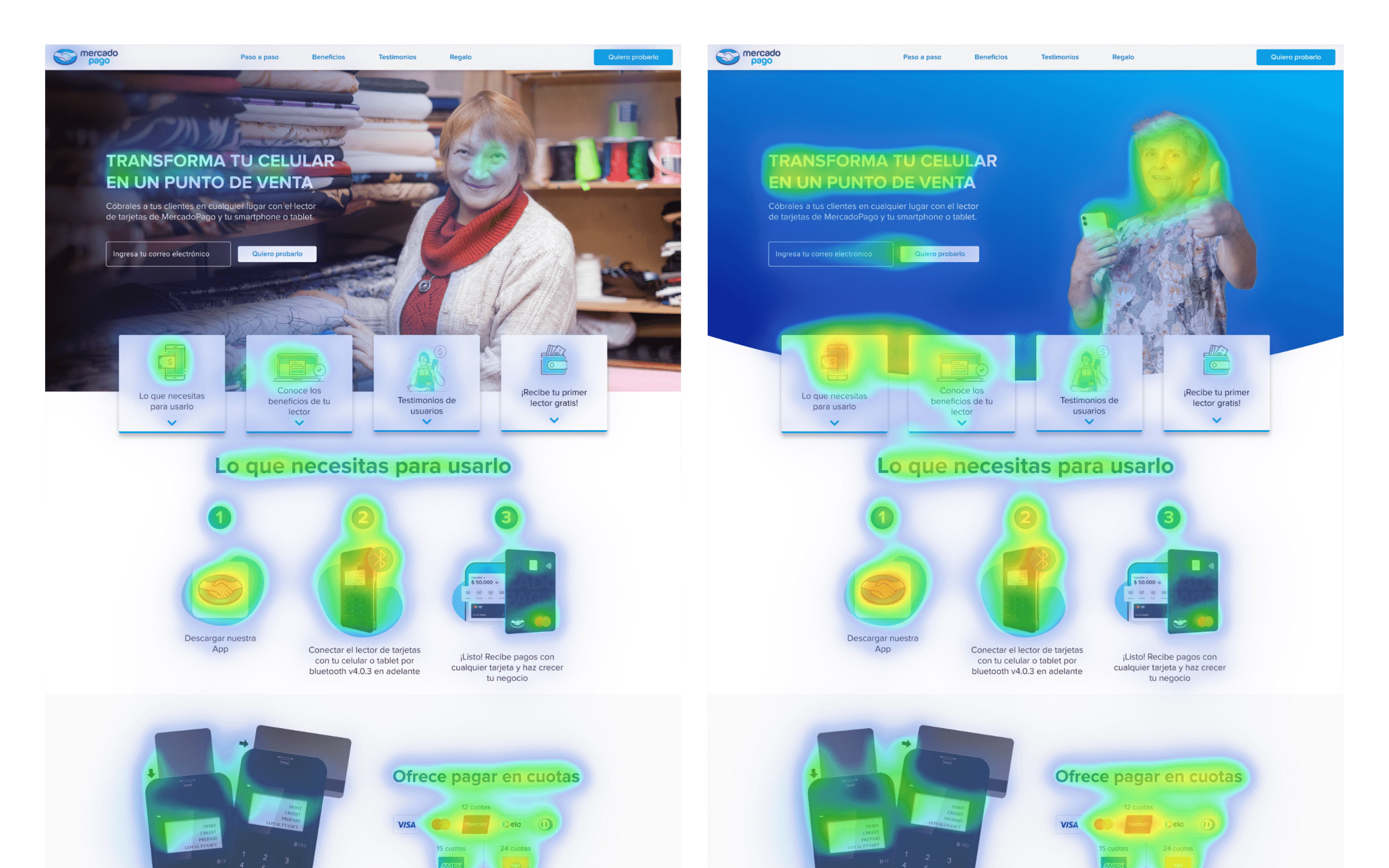
Instead of showcasing features, the landing emphasized ease of use, free first device, and testimonials from relatable business owners.
Rationale: Persuasion through testimonials (“If she could do it, so can I”) works better than specs.
Impact: Page sections were ordered to mirror the user journey: 1) why adopt, 2) how it works, 3) who’s using it.
Outcome: Landing is emotionally resonant, conversion-focused, and mobile-optimized.
Measurable Results
Area | Observation | Outcome |
|---|---|---|
Research | 12 user interviews, 58% had never used card readers before. | Key insight: resistance due to misinformation, not tech. |
UX/UI | Adaptive error flows, CTA prioritization, user-language copy | Reduced friction and improved guidance in user testing |
Prototyping | Payment flow refined to include validation and retry logic. | Validated through prototyping with edge-case scenarios. |
Landing Page | Benefit-first structure, testimonials, step-by-step visuals | Higher user recall of benefits and CTAs in testing |
Component System | Design tokens and UI Kit aligned with Mercado Libre's Andes UI | Design consistency + developer handoff ready |
Learnings
UX doesn’t end with usability — it starts with cultural empathy.
Tools like POS readers are useless if they don’t feel trustworthy or familiar.
“Simple” is not simplistic.
Writing in everyday language helps remove intimidation — especially for first-time tech adopters.Designing for local realities = designing for dignity.
Many small merchants don’t lack capacity — they lack clear, respectful access to the right tools.
“In low-trust environments, every screen must prove that the product understands you — not just works.”
🔗 Explore the Full Project
💻 Benchmarking
🧠 UX Research
📍 User flow
🧩 UI Kit
🚀 Interactive Prototype Flow
🌐 Landing Page
💼 linkedin.com/in/hermeslopez1
Mercado Pago POS Experience
Introducing card payments to small merchants in Colombia through UX strategy, research, and interface design.
Year :
2024
Industry :
Fintech – B2B Payments
Client :
Mercado Pago
Strategic Challenge
While Mercado Pago is well known across LATAM, its physical POS (Point of Sale) reader had low awareness and adoption in Colombia, especially among small business owners who rely heavily on cash and informal payment methods.
The challenge wasn’t to “design a screen,” but to design trust.
Hypothesis: By researching the specific hesitations and behaviors of Colombian merchants, we could design an experience that feels accessible, intuitive, and relevant to users unfamiliar with digital POS tools.
Goal: Redesign the payment flow and promotional landing page for Mercado Pago’s POS reader with localized UX strategy and real user insights.
Critical Design Decisions
🔍 Decision 1 — Research local adoption barriers through interviews
I conducted interviews with 12 microbusiness owners across sectors like fashion, retail, and services.
Rationale: Colombia has unique tech-cultural gaps around payment tech, often based on mistrust and misinformation.
Insight: 58% had never used a POS system, mostly due to perceived complexity or cost.
Outcome: Defined a new persona ("Clara", a 51-year-old seamstress) whose emotional resistance shaped all UX decisions.
📊 Decision 2 — Map emotional & technical friction in the payment flow
Mapped a complete POS flow including both "happy paths" and friction points like failed Bluetooth connection, chip errors, or incorrect card type.
Rationale: In low-trust environments, clarity and feedback are more important than visual polish.
Impact: Added microinteractions and snackbars that confirm state changes and errors clearly.
Outcome: Reduced decision anxiety by surfacing clear steps and fallback options.
🎨 Decision 3 — Adapt UI copy to match users’ language and confidence
Copy was rewritten to feel simpler, more conversational, and culturally attuned to Colombian merchants.
Rationale: Many users rejected tools simply because the language sounded "too technical."
Impact: Added warmth and everyday tone to key moments like feedback screens and landing benefit sections.
Outcome: Higher empathy and lower abandonment in usability tests.
📱 Decision 4 — Design a landing page focused on trust, benefits, and social proof
Instead of showcasing features, the landing emphasized ease of use, free first device, and testimonials from relatable business owners.
Rationale: Persuasion through testimonials (“If she could do it, so can I”) works better than specs.
Impact: Page sections were ordered to mirror the user journey: 1) why adopt, 2) how it works, 3) who’s using it.
Outcome: Landing is emotionally resonant, conversion-focused, and mobile-optimized.
Measurable Results
Area | Observation | Outcome |
|---|---|---|
Research | 12 user interviews, 58% had never used card readers before. | Key insight: resistance due to misinformation, not tech. |
UX/UI | Adaptive error flows, CTA prioritization, user-language copy | Reduced friction and improved guidance in user testing |
Prototyping | Payment flow refined to include validation and retry logic. | Validated through prototyping with edge-case scenarios. |
Landing Page | Benefit-first structure, testimonials, step-by-step visuals | Higher user recall of benefits and CTAs in testing |
Component System | Design tokens and UI Kit aligned with Mercado Libre's Andes UI | Design consistency + developer handoff ready |
Learnings
UX doesn’t end with usability — it starts with cultural empathy.
Tools like POS readers are useless if they don’t feel trustworthy or familiar.
“Simple” is not simplistic.
Writing in everyday language helps remove intimidation — especially for first-time tech adopters.Designing for local realities = designing for dignity.
Many small merchants don’t lack capacity — they lack clear, respectful access to the right tools.
“In low-trust environments, every screen must prove that the product understands you — not just works.”
🔗 Explore the Full Project
💻 Benchmarking
🧠 UX Research
📍 User flow
🧩 UI Kit
🚀 Interactive Prototype Flow
🌐 Landing Page
💼 linkedin.com/in/hermeslopez1
Mercado Pago POS Experience
Introducing card payments to small merchants in Colombia through UX strategy, research, and interface design.
Year :
2024
Industry :
Fintech – B2B Payments
Client :
Mercado Pago
Strategic Challenge
While Mercado Pago is well known across LATAM, its physical POS (Point of Sale) reader had low awareness and adoption in Colombia, especially among small business owners who rely heavily on cash and informal payment methods.
The challenge wasn’t to “design a screen,” but to design trust.
Hypothesis: By researching the specific hesitations and behaviors of Colombian merchants, we could design an experience that feels accessible, intuitive, and relevant to users unfamiliar with digital POS tools.
Goal: Redesign the payment flow and promotional landing page for Mercado Pago’s POS reader with localized UX strategy and real user insights.
Critical Design Decisions
🔍 Decision 1 — Research local adoption barriers through interviews
I conducted interviews with 12 microbusiness owners across sectors like fashion, retail, and services.
Rationale: Colombia has unique tech-cultural gaps around payment tech, often based on mistrust and misinformation.
Insight: 58% had never used a POS system, mostly due to perceived complexity or cost.
Outcome: Defined a new persona ("Clara", a 51-year-old seamstress) whose emotional resistance shaped all UX decisions.
📊 Decision 2 — Map emotional & technical friction in the payment flow
Mapped a complete POS flow including both "happy paths" and friction points like failed Bluetooth connection, chip errors, or incorrect card type.
Rationale: In low-trust environments, clarity and feedback are more important than visual polish.
Impact: Added microinteractions and snackbars that confirm state changes and errors clearly.
Outcome: Reduced decision anxiety by surfacing clear steps and fallback options.
🎨 Decision 3 — Adapt UI copy to match users’ language and confidence
Copy was rewritten to feel simpler, more conversational, and culturally attuned to Colombian merchants.
Rationale: Many users rejected tools simply because the language sounded "too technical."
Impact: Added warmth and everyday tone to key moments like feedback screens and landing benefit sections.
Outcome: Higher empathy and lower abandonment in usability tests.
📱 Decision 4 — Design a landing page focused on trust, benefits, and social proof
Instead of showcasing features, the landing emphasized ease of use, free first device, and testimonials from relatable business owners.
Rationale: Persuasion through testimonials (“If she could do it, so can I”) works better than specs.
Impact: Page sections were ordered to mirror the user journey: 1) why adopt, 2) how it works, 3) who’s using it.
Outcome: Landing is emotionally resonant, conversion-focused, and mobile-optimized.
Measurable Results
Area | Observation | Outcome |
|---|---|---|
Research | 12 user interviews, 58% had never used card readers before. | Key insight: resistance due to misinformation, not tech. |
UX/UI | Adaptive error flows, CTA prioritization, user-language copy | Reduced friction and improved guidance in user testing |
Prototyping | Payment flow refined to include validation and retry logic. | Validated through prototyping with edge-case scenarios. |
Landing Page | Benefit-first structure, testimonials, step-by-step visuals | Higher user recall of benefits and CTAs in testing |
Component System | Design tokens and UI Kit aligned with Mercado Libre's Andes UI | Design consistency + developer handoff ready |
Learnings
UX doesn’t end with usability — it starts with cultural empathy.
Tools like POS readers are useless if they don’t feel trustworthy or familiar.
“Simple” is not simplistic.
Writing in everyday language helps remove intimidation — especially for first-time tech adopters.Designing for local realities = designing for dignity.
Many small merchants don’t lack capacity — they lack clear, respectful access to the right tools.
“In low-trust environments, every screen must prove that the product understands you — not just works.”
🔗 Explore the Full Project
💻 Benchmarking
🧠 UX Research
📍 User flow
🧩 UI Kit
🚀 Interactive Prototype Flow
🌐 Landing Page
💼 linkedin.com/in/hermeslopez1