Driver Retention Early-Warning System
Capturing daily driver signals through in-cab tablet surveys and transforming them into actionable retention insights through an AI-powered fleet management web application.
Year :
2026
Industry :
HR Logistics - B2B
Client :
Roadpact
Strategic Challenge
Fleet companies rarely lose drivers suddenly. They accumulate frustrations until leaving becomes inevitable.
Operational friction builds slowly through issues such as scheduling pressure, poor equipment conditions, unsafe routes, or dispatch conflicts. These signals often appear weeks before a driver resigns, but they remain invisible to traditional HR tools.
Most organizations rely on exit interviews, which explain past decisions but fail to identify early disengagement signals.
Design Hypothesis
If fleets could capture daily driver sentiment and operational friction signals, they could detect early patterns of disengagement and intervene before drivers resign.
Note: Some details and interface elements have been simplified or anonymized to protect sensitive product and customer data.
Critical Design Decisions
Decision 1 — Capture signals in an easy way
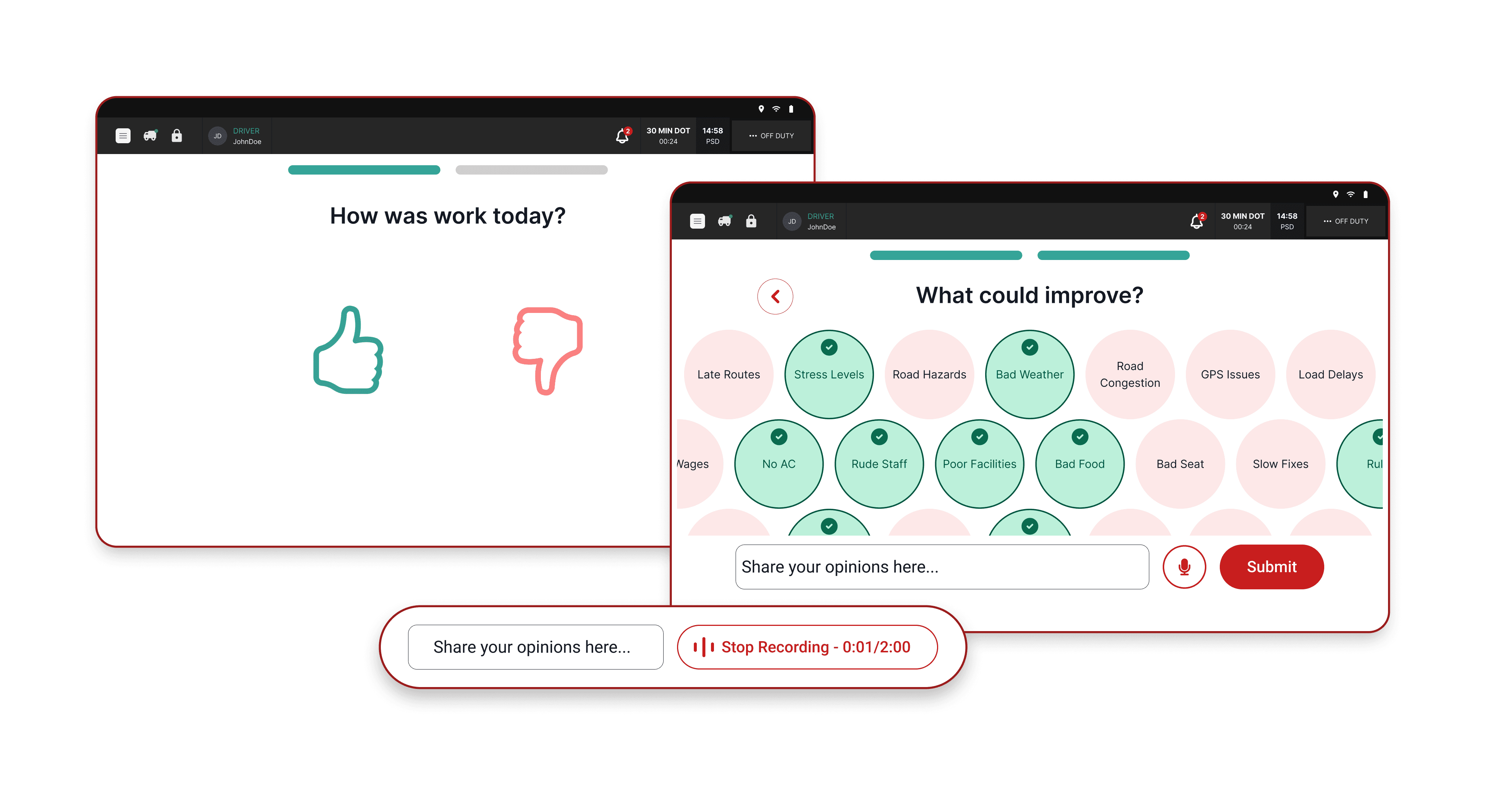
My first design split this across multiple screens with fewer options per screen — the logic was reducing cognitive load per step. But in usability testing, drivers reported it felt too long. I measured completion time: 3 minutes. That's too much friction for someone between routes.
So I iterate and consolidate a to 2 screens flow.
Boolean: Mood signal (good / bad day)
Multi-input: Friction tags + voice or text feedback (optional)
Completion time dropped to 1 minute 50 seconds — a 40% improvement in data collection speed, with no loss in response quality measured across the same usability sessions.
Because the interface relies on visual recognition instead of reading, the interaction becomes easier to complete over time as drivers grow familiar with the pattern.
Decision 2 — Transform operational friction into structured signals
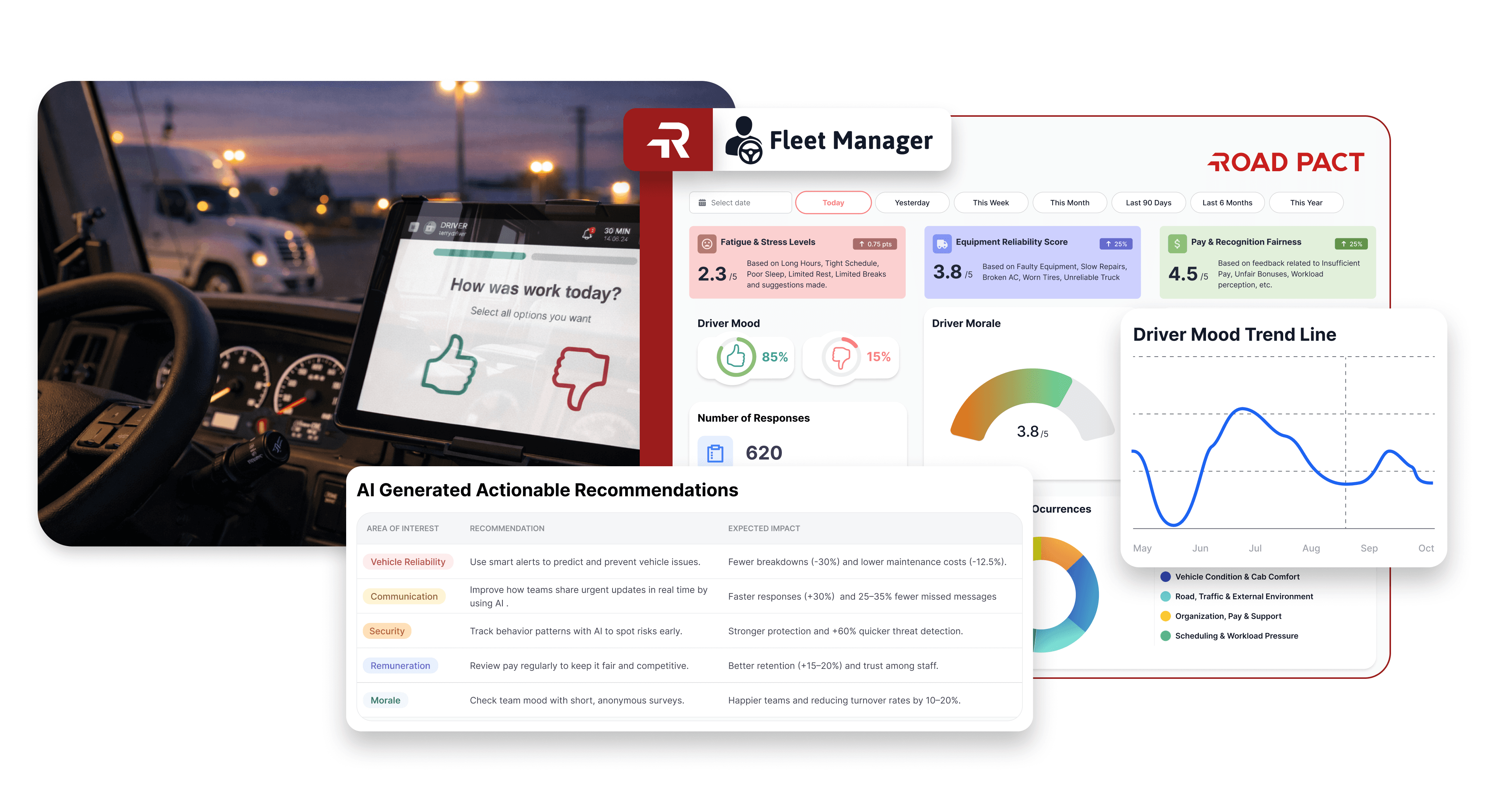
On the manager side, I designed a dashboard that aggregates driver mood trends, top friction categories, severity scores by areas — Wellbeing, Operations, Equipment, Environment — this structure converts qualitative feedback into structured signals that can be aggregated and analyzed.
An AI Sentiment Analysis Algorithm processes open feedback (text and speech) weighting responses differently depending on tone, sentiment intensity, and recurring patterns.
Decision 3 — Design dashboards that reveal operational patterns
Fleet managers need to interpret signals quickly and translate them into operational action.
The dashboard layer visualizes the same dataset through multiple perspectives:
fleet health indicators
friction category distribution
driver sentiment trends over time
emerging operational risks
These views help teams identify whether issues originate from:
equipment
scheduling
management processes
external conditions
Instead of simply displaying data, the dashboard is designed to support operational decision-making.
I validated the dashboard with fleet managers using a SUS scale — System Usability Scale — and scored 90% acceptance on perceived utility.
Decision 4 — Enable incident-level auditing of driver signals
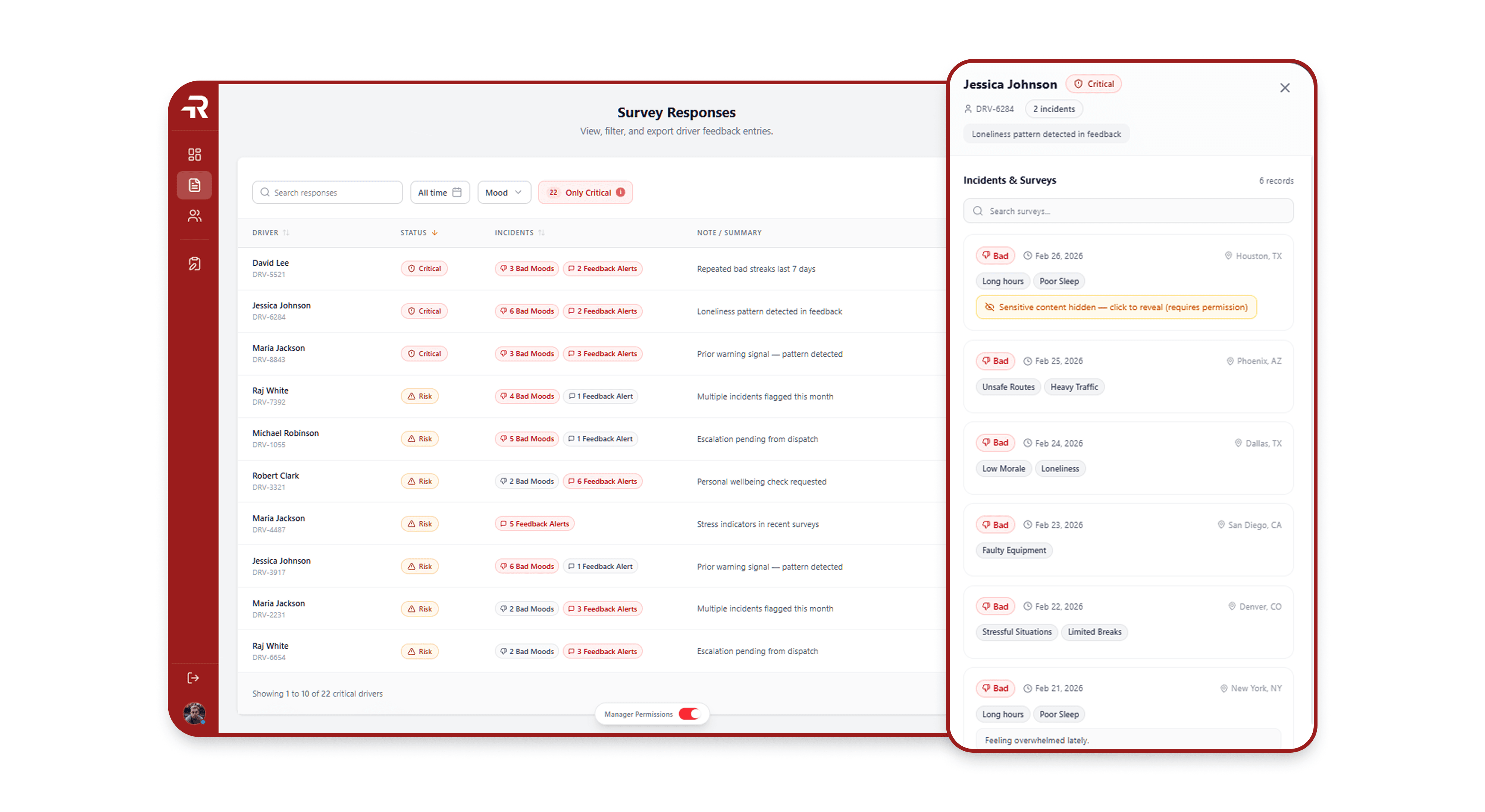
Beyond aggregated insights, the system includes a detailed response inspection interface where managers can review feedback entries individually.
This view allows teams to:
audit survey responses
detect recurring signals from specific drivers
investigate critical incidents flagged by the system
track historical feedback patterns
Critical alerts are defined through this layer, where repeated negative signals or specific keywords trigger early warnings.
This combination of aggregate insights and individual signal auditing helps organizations distinguish between isolated frustration and systemic problems.
Decision 5 — Build a prototype capable of selling the system
The product was designed before backend infrastructure existed.
A fully navigable prototype was created using:
simulated datasets
local-storage interaction logic
interactive dashboards
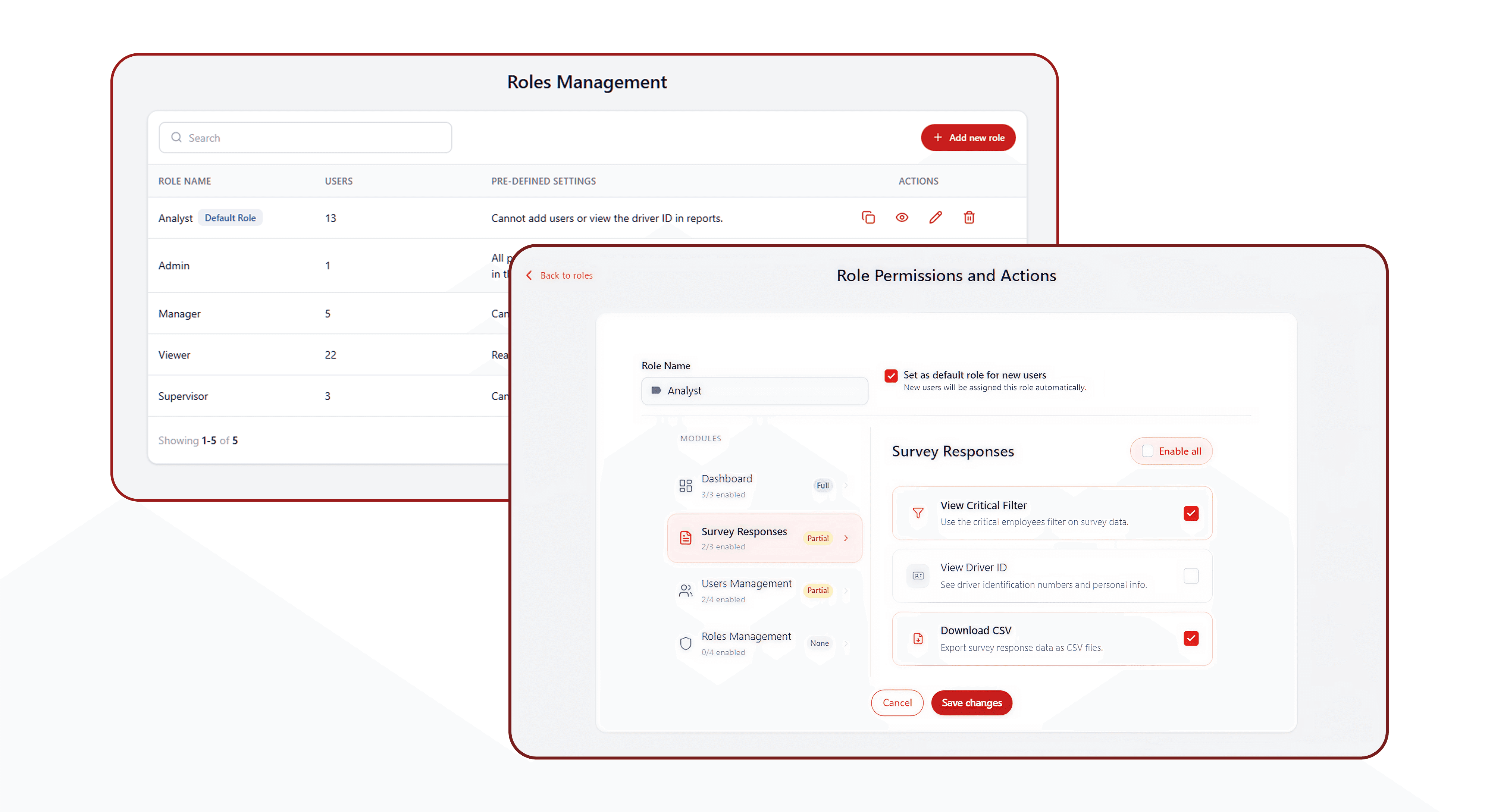
role-based access simulation
This allowed stakeholders and potential investors to experience the system behavior and validate the concept before engineering investment.
Results
Metric | Improvement | Outcome |
|---|---|---|
Raw data collection | Redesign of daily form layout and flow. | 40% improvement in data collection speed, with no loss in response quality. |
Driver feedback structure | Design of an operational dashboard with actionable insights | System Usability Scale scored 90% acceptance on perceived utility |
Product market validation | AI coded Interactive prototype | Enabled stakeholders buy-in pilots |
Design Trade-offs
1. Survey data richness vs Cognitive load
It was counterintuitive to kept only two screens survey (the second overcrowded), instead of add more screens and minimize the cognitive load. The testing shows better completion time rates, with same data quality output. So it was better accepting fewer screens with more data points per session and relying on repeated daily signals to reveal patterns.
Early signals vs false positives
Avoided triggering “risk” from single bad days; used streaks logics, recurrence in qualitative feedback, and weighted indicators to reduce noise and focus attention on sustained patterns.
3. Driver privacy vs operational visibility
Implemented role-based access to protect sensitive identifiers while still enabling HR/Managers to take action, trading granular transparency for trust, compliance, and enterprise adoption.
Learnings
AI-coded prototypes can sell ideas faster by making the system tangible for stakeholders and investors before engineering investment.
Low-friction inputs win adoption — small daily signals outperform long surveys when participation is the goal.
Value comes from transformation, not collection — turning qualitative feedback into structured signals is what enables action.
🔗 Explore the Full Project
🌐 Product Website Link
🚀Schedule a Demo for your company Link
💼 Designed by Hermes López Alba
Driver Retention Early-Warning System
Capturing daily driver signals through in-cab tablet surveys and transforming them into actionable retention insights through an AI-powered fleet management web application.
Year :
2026
Industry :
HR Logistics - B2B
Client :
Roadpact
Strategic Challenge
Fleet companies rarely lose drivers suddenly. They accumulate frustrations until leaving becomes inevitable.
Operational friction builds slowly through issues such as scheduling pressure, poor equipment conditions, unsafe routes, or dispatch conflicts. These signals often appear weeks before a driver resigns, but they remain invisible to traditional HR tools.
Most organizations rely on exit interviews, which explain past decisions but fail to identify early disengagement signals.
Design Hypothesis
If fleets could capture daily driver sentiment and operational friction signals, they could detect early patterns of disengagement and intervene before drivers resign.
Note: Some details and interface elements have been simplified or anonymized to protect sensitive product and customer data.
Critical Design Decisions
Decision 1 — Capture signals in an easy way
My first design split this across multiple screens with fewer options per screen — the logic was reducing cognitive load per step. But in usability testing, drivers reported it felt too long. I measured completion time: 3 minutes. That's too much friction for someone between routes.
So I iterate and consolidate a to 2 screens flow.
Boolean: Mood signal (good / bad day)
Multi-input: Friction tags + voice or text feedback (optional)
Completion time dropped to 1 minute 50 seconds — a 40% improvement in data collection speed, with no loss in response quality measured across the same usability sessions.
Because the interface relies on visual recognition instead of reading, the interaction becomes easier to complete over time as drivers grow familiar with the pattern.
Decision 2 — Transform operational friction into structured signals
On the manager side, I designed a dashboard that aggregates driver mood trends, top friction categories, severity scores by areas — Wellbeing, Operations, Equipment, Environment — this structure converts qualitative feedback into structured signals that can be aggregated and analyzed.
An AI Sentiment Analysis Algorithm processes open feedback (text and speech) weighting responses differently depending on tone, sentiment intensity, and recurring patterns.
Decision 3 — Design dashboards that reveal operational patterns
Fleet managers need to interpret signals quickly and translate them into operational action.
The dashboard layer visualizes the same dataset through multiple perspectives:
fleet health indicators
friction category distribution
driver sentiment trends over time
emerging operational risks
These views help teams identify whether issues originate from:
equipment
scheduling
management processes
external conditions
Instead of simply displaying data, the dashboard is designed to support operational decision-making.
I validated the dashboard with fleet managers using a SUS scale — System Usability Scale — and scored 90% acceptance on perceived utility.
Decision 4 — Enable incident-level auditing of driver signals
Beyond aggregated insights, the system includes a detailed response inspection interface where managers can review feedback entries individually.
This view allows teams to:
audit survey responses
detect recurring signals from specific drivers
investigate critical incidents flagged by the system
track historical feedback patterns
Critical alerts are defined through this layer, where repeated negative signals or specific keywords trigger early warnings.
This combination of aggregate insights and individual signal auditing helps organizations distinguish between isolated frustration and systemic problems.
Decision 5 — Build a prototype capable of selling the system
The product was designed before backend infrastructure existed.
A fully navigable prototype was created using:
simulated datasets
local-storage interaction logic
interactive dashboards
role-based access simulation
This allowed stakeholders and potential investors to experience the system behavior and validate the concept before engineering investment.
Results
Metric | Improvement | Outcome |
|---|---|---|
Raw data collection | Redesign of daily form layout and flow. | 40% improvement in data collection speed, with no loss in response quality. |
Driver feedback structure | Design of an operational dashboard with actionable insights | System Usability Scale scored 90% acceptance on perceived utility |
Product market validation | AI coded Interactive prototype | Enabled stakeholders buy-in pilots |
Design Trade-offs
1. Survey data richness vs Cognitive load
It was counterintuitive to kept only two screens survey (the second overcrowded), instead of add more screens and minimize the cognitive load. The testing shows better completion time rates, with same data quality output. So it was better accepting fewer screens with more data points per session and relying on repeated daily signals to reveal patterns.
Early signals vs false positives
Avoided triggering “risk” from single bad days; used streaks logics, recurrence in qualitative feedback, and weighted indicators to reduce noise and focus attention on sustained patterns.
3. Driver privacy vs operational visibility
Implemented role-based access to protect sensitive identifiers while still enabling HR/Managers to take action, trading granular transparency for trust, compliance, and enterprise adoption.
Learnings
AI-coded prototypes can sell ideas faster by making the system tangible for stakeholders and investors before engineering investment.
Low-friction inputs win adoption — small daily signals outperform long surveys when participation is the goal.
Value comes from transformation, not collection — turning qualitative feedback into structured signals is what enables action.
🔗 Explore the Full Project
🌐 Product Website Link
🚀Schedule a Demo for your company Link
💼 Designed by Hermes López Alba
Driver Retention Early-Warning System
Capturing daily driver signals through in-cab tablet surveys and transforming them into actionable retention insights through an AI-powered fleet management web application.
Year :
2026
Industry :
HR Logistics - B2B
Client :
Roadpact
Strategic Challenge
Fleet companies rarely lose drivers suddenly. They accumulate frustrations until leaving becomes inevitable.
Operational friction builds slowly through issues such as scheduling pressure, poor equipment conditions, unsafe routes, or dispatch conflicts. These signals often appear weeks before a driver resigns, but they remain invisible to traditional HR tools.
Most organizations rely on exit interviews, which explain past decisions but fail to identify early disengagement signals.
Design Hypothesis
If fleets could capture daily driver sentiment and operational friction signals, they could detect early patterns of disengagement and intervene before drivers resign.
Note: Some details and interface elements have been simplified or anonymized to protect sensitive product and customer data.
Critical Design Decisions
Decision 1 — Capture signals in an easy way
My first design split this across multiple screens with fewer options per screen — the logic was reducing cognitive load per step. But in usability testing, drivers reported it felt too long. I measured completion time: 3 minutes. That's too much friction for someone between routes.
So I iterate and consolidate a to 2 screens flow.
Boolean: Mood signal (good / bad day)
Multi-input: Friction tags + voice or text feedback (optional)
Completion time dropped to 1 minute 50 seconds — a 40% improvement in data collection speed, with no loss in response quality measured across the same usability sessions.
Because the interface relies on visual recognition instead of reading, the interaction becomes easier to complete over time as drivers grow familiar with the pattern.
Decision 2 — Transform operational friction into structured signals
On the manager side, I designed a dashboard that aggregates driver mood trends, top friction categories, severity scores by areas — Wellbeing, Operations, Equipment, Environment — this structure converts qualitative feedback into structured signals that can be aggregated and analyzed.
An AI Sentiment Analysis Algorithm processes open feedback (text and speech) weighting responses differently depending on tone, sentiment intensity, and recurring patterns.
Decision 3 — Design dashboards that reveal operational patterns
Fleet managers need to interpret signals quickly and translate them into operational action.
The dashboard layer visualizes the same dataset through multiple perspectives:
fleet health indicators
friction category distribution
driver sentiment trends over time
emerging operational risks
These views help teams identify whether issues originate from:
equipment
scheduling
management processes
external conditions
Instead of simply displaying data, the dashboard is designed to support operational decision-making.
I validated the dashboard with fleet managers using a SUS scale — System Usability Scale — and scored 90% acceptance on perceived utility.
Decision 4 — Enable incident-level auditing of driver signals
Beyond aggregated insights, the system includes a detailed response inspection interface where managers can review feedback entries individually.
This view allows teams to:
audit survey responses
detect recurring signals from specific drivers
investigate critical incidents flagged by the system
track historical feedback patterns
Critical alerts are defined through this layer, where repeated negative signals or specific keywords trigger early warnings.
This combination of aggregate insights and individual signal auditing helps organizations distinguish between isolated frustration and systemic problems.
Decision 5 — Build a prototype capable of selling the system
The product was designed before backend infrastructure existed.
A fully navigable prototype was created using:
simulated datasets
local-storage interaction logic
interactive dashboards
role-based access simulation
This allowed stakeholders and potential investors to experience the system behavior and validate the concept before engineering investment.
Results
Metric | Improvement | Outcome |
|---|---|---|
Raw data collection | Redesign of daily form layout and flow. | 40% improvement in data collection speed, with no loss in response quality. |
Driver feedback structure | Design of an operational dashboard with actionable insights | System Usability Scale scored 90% acceptance on perceived utility |
Product market validation | AI coded Interactive prototype | Enabled stakeholders buy-in pilots |
Design Trade-offs
1. Survey data richness vs Cognitive load
It was counterintuitive to kept only two screens survey (the second overcrowded), instead of add more screens and minimize the cognitive load. The testing shows better completion time rates, with same data quality output. So it was better accepting fewer screens with more data points per session and relying on repeated daily signals to reveal patterns.
Early signals vs false positives
Avoided triggering “risk” from single bad days; used streaks logics, recurrence in qualitative feedback, and weighted indicators to reduce noise and focus attention on sustained patterns.
3. Driver privacy vs operational visibility
Implemented role-based access to protect sensitive identifiers while still enabling HR/Managers to take action, trading granular transparency for trust, compliance, and enterprise adoption.
Learnings
AI-coded prototypes can sell ideas faster by making the system tangible for stakeholders and investors before engineering investment.
Low-friction inputs win adoption — small daily signals outperform long surveys when participation is the goal.
Value comes from transformation, not collection — turning qualitative feedback into structured signals is what enables action.
🔗 Explore the Full Project
🌐 Product Website Link
🚀Schedule a Demo for your company Link
💼 Designed by Hermes López Alba