Travel Management Platform Redesign
Turning a fragmented travel management system into a structured, scalable, and decision-driven product.
Year :
2025
Industry :
SaaS - B2B
Client :
OK Roger TMS
STRATEGIC CHALLENGE
OK Roger’s platform allowed companies to manage business travel, but the admin experience was broken.
Confusing Information Architecture, repetitive flows, and a lack of governance made it hard for teams to scale.
How might we design an experience where administrators feel fully in control — without extra training, complexity, or risk?

Critical Design Decisions
🧠 Decision 1 — Reframe the architecture around user intent
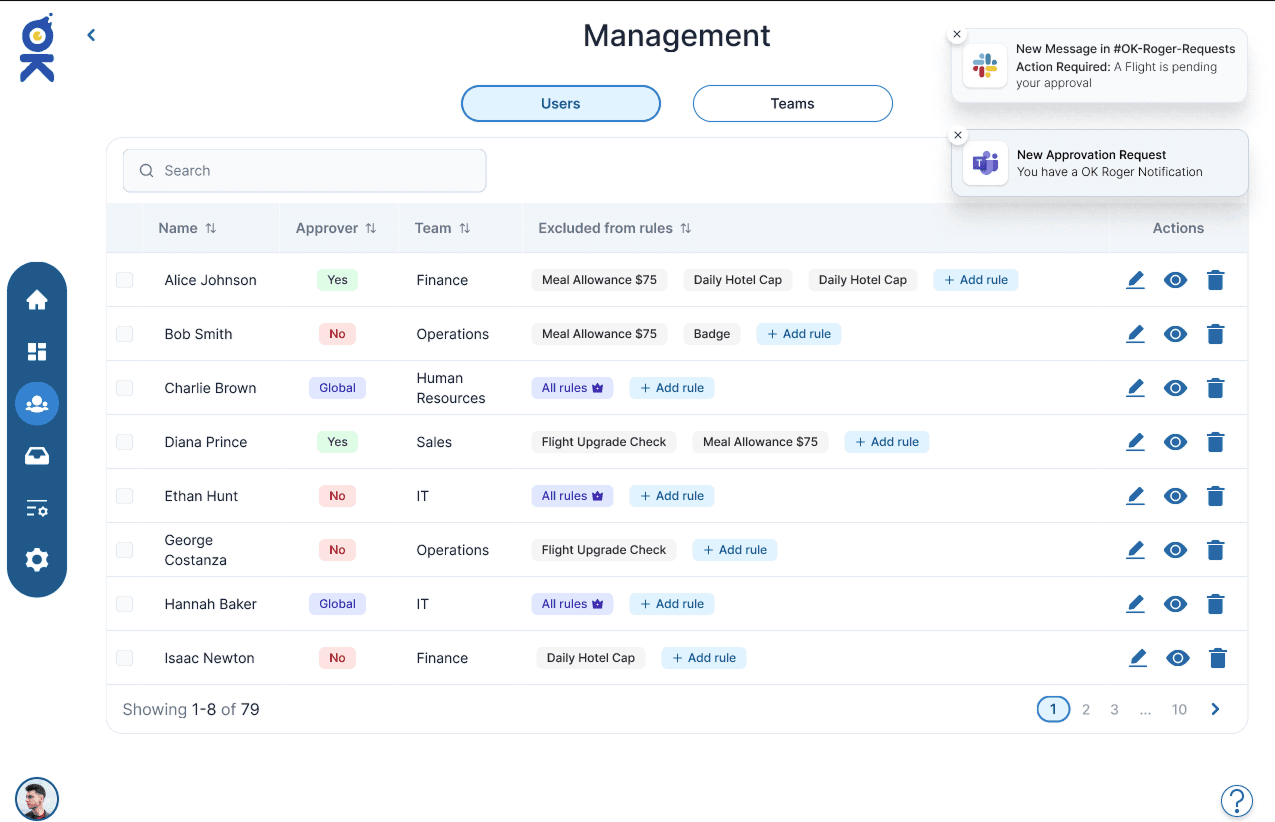
I replaced a system-based structure (Policies, Reports, Users) with a task-based model (Staff Management, Policies, Approval Inbox, Dashboard, Settings).
Reduced navigation depth by 40%.
Introduced clear parent-child relationships for discoverability.
Why:
Admins don’t think in modules — they think in actions and outcomes.
⚙️ Decision 2 — Build a guided onboarding that creates momentum
Designed a 5-step assisted flow (“Set it and forget it”) that mirrors the natural setup process:
Company setup → 2. Add users → 3. Create teams → 4. Set rules → 5. Check dashboard.
Reduced setup time from 45 → 8 minutes.
Cut redundant screens by 50%.
Added visual feedback and progress tracking.
Why:
Speed builds trust. Trust builds adoption.
🧩 Decision 3 — Merge approvals, rules, and governance
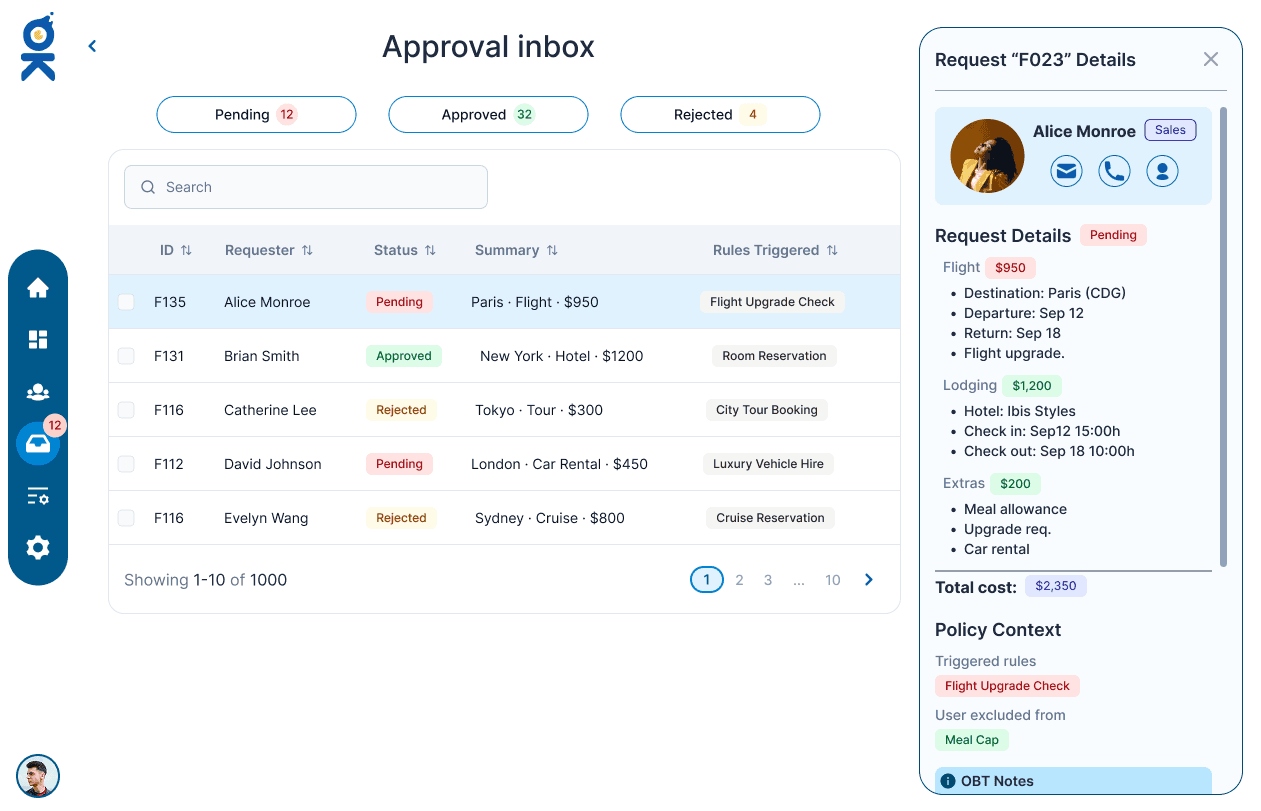
Created an Approval Inbox with context-rich decisions and full audit history.
Linked rules, users, and transactions into one traceable system.
100% visibility over triggered rules.
One-click approval without context loss.
Why:
Governance isn’t just control — it’s clarity.
📊 Decision 4 — Design dashboards that drive action
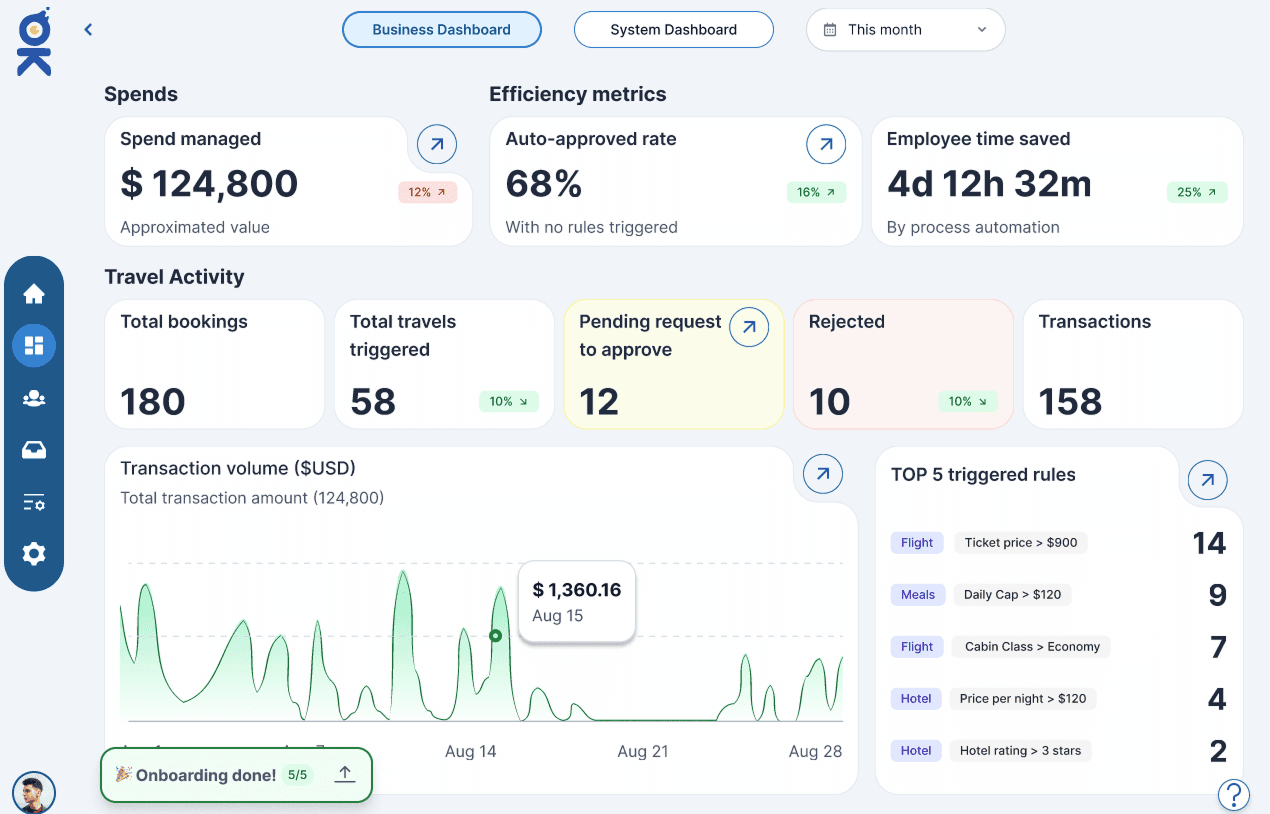
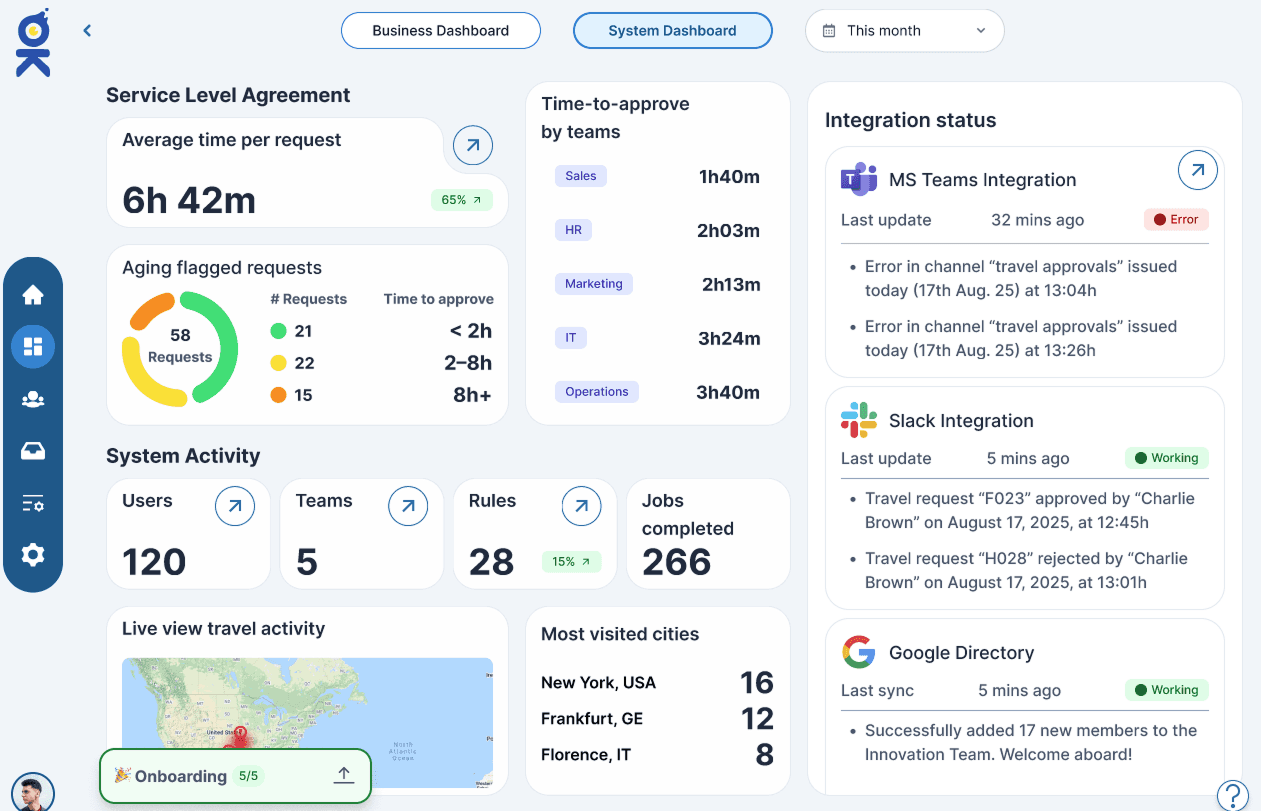
Developed two dashboards for different mental models:
Business: Spend, ROI, efficiency.
System: SLA, integrations, team activity.
Enabled drill-down without page reloads.
+40% increase in perceived control (from internal testing).
Why:
Data isn’t valuable unless it changes behavior.
Measurable Results
Metric | Before | After | Impact |
|---|---|---|---|
Setup time | 45 min | 8 min | 80% faster onboarding |
IA depth | 11 modules 3 levels | 7 modules 4 levels | +40% clarity |
Flow steps | 10 | 5 | -50% complexity |
Perceived control | 30% | 70% | +40% comprehension |
The redesign transformed OK Roger into a platform that communicates control, not complexity.
👨🏻💻 System & Implementation
Tailwind CSS class-based structure for dev handoff.
Accessible color system (AA+).
Modular cards and tables for scalability.
Dashboards + drill-downs
Learnings
Designing for enterprise means designing for alignment — not decoration.
A good Info. Architecture turns decision-making into a repeatable, auditable process.
A good UX/UI makes that process feel effortless.
🔗 Explore the Full Project
📄Old platform OK Roger
🧠 Rational Process: Figjam File
🧩 UI Kit Tailwind classes based Figma Page
🚀Redesigned platform: Figma Screens - Onboarding Prototype Flow
Travel Management Platform Redesign
Turning a fragmented travel management system into a structured, scalable, and decision-driven product.
Year :
2025
Industry :
SaaS - B2B
Client :
OK Roger TMS
STRATEGIC CHALLENGE
OK Roger’s platform allowed companies to manage business travel, but the admin experience was broken.
Confusing Information Architecture, repetitive flows, and a lack of governance made it hard for teams to scale.
How might we design an experience where administrators feel fully in control — without extra training, complexity, or risk?
Critical Design Decisions
🧠 Decision 1 — Reframe the architecture around user intent
I replaced a system-based structure (Policies, Reports, Users) with a task-based model (Staff Management, Policies, Approval Inbox, Dashboard, Settings).
Reduced navigation depth by 40%.
Introduced clear parent-child relationships for discoverability.
Why:
Admins don’t think in modules — they think in actions and outcomes.
⚙️ Decision 2 — Build a guided onboarding that creates momentum
Designed a 5-step assisted flow (“Set it and forget it”) that mirrors the natural setup process:
Company setup → 2. Add users → 3. Create teams → 4. Set rules → 5. Check dashboard.
Reduced setup time from 45 → 8 minutes.
Cut redundant screens by 50%.
Added visual feedback and progress tracking.
Why:
Speed builds trust. Trust builds adoption.
🧩 Decision 3 — Merge approvals, rules, and governance
Created an Approval Inbox with context-rich decisions and full audit history.
Linked rules, users, and transactions into one traceable system.
100% visibility over triggered rules.
One-click approval without context loss.
Why:
Governance isn’t just control — it’s clarity.
📊 Decision 4 — Design dashboards that drive action
Developed two dashboards for different mental models:
Business: Spend, ROI, efficiency.
System: SLA, integrations, team activity.
Enabled drill-down without page reloads.
+40% increase in perceived control (from internal testing).
Why:
Data isn’t valuable unless it changes behavior.
Measurable Results
Metric | Before | After | Impact |
|---|---|---|---|
Setup time | 45 min | 8 min | 80% faster onboarding |
IA depth | 11 modules 3 levels | 7 modules 4 levels | +40% clarity |
Flow steps | 10 | 5 | -50% complexity |
Perceived control | 30% | 70% | +40% comprehension |
The redesign transformed OK Roger into a platform that communicates control, not complexity.
👨🏻💻 System & Implementation
Tailwind CSS class-based structure for dev handoff.
Accessible color system (AA+).
Modular cards and tables for scalability.
Dashboards + drill-downs
Learnings
Designing for enterprise means designing for alignment — not decoration.
A good Info. Architecture turns decision-making into a repeatable, auditable process.
A good UX/UI makes that process feel effortless.
🔗 Explore the Full Project
📄Old platform OK Roger
🧠 Rational Process: Figjam File
🧩 UI Kit Tailwind classes based Figma Page
🚀Redesigned platform: Figma Screens - Onboarding Prototype Flow
Travel Management Platform Redesign
Turning a fragmented travel management system into a structured, scalable, and decision-driven product.
Year :
2025
Industry :
SaaS - B2B
Client :
OK Roger TMS
STRATEGIC CHALLENGE
OK Roger’s platform allowed companies to manage business travel, but the admin experience was broken.
Confusing Information Architecture, repetitive flows, and a lack of governance made it hard for teams to scale.
How might we design an experience where administrators feel fully in control — without extra training, complexity, or risk?
Critical Design Decisions
🧠 Decision 1 — Reframe the architecture around user intent
I replaced a system-based structure (Policies, Reports, Users) with a task-based model (Staff Management, Policies, Approval Inbox, Dashboard, Settings).
Reduced navigation depth by 40%.
Introduced clear parent-child relationships for discoverability.
Why:
Admins don’t think in modules — they think in actions and outcomes.
⚙️ Decision 2 — Build a guided onboarding that creates momentum
Designed a 5-step assisted flow (“Set it and forget it”) that mirrors the natural setup process:
Company setup → 2. Add users → 3. Create teams → 4. Set rules → 5. Check dashboard.
Reduced setup time from 45 → 8 minutes.
Cut redundant screens by 50%.
Added visual feedback and progress tracking.
Why:
Speed builds trust. Trust builds adoption.
🧩 Decision 3 — Merge approvals, rules, and governance
Created an Approval Inbox with context-rich decisions and full audit history.
Linked rules, users, and transactions into one traceable system.
100% visibility over triggered rules.
One-click approval without context loss.
Why:
Governance isn’t just control — it’s clarity.
📊 Decision 4 — Design dashboards that drive action
Developed two dashboards for different mental models:
Business: Spend, ROI, efficiency.
System: SLA, integrations, team activity.
Enabled drill-down without page reloads.
+40% increase in perceived control (from internal testing).
Why:
Data isn’t valuable unless it changes behavior.
Measurable Results
Metric | Before | After | Impact |
|---|---|---|---|
Setup time | 45 min | 8 min | 80% faster onboarding |
IA depth | 11 modules 3 levels | 7 modules 4 levels | +40% clarity |
Flow steps | 10 | 5 | -50% complexity |
Perceived control | 30% | 70% | +40% comprehension |
The redesign transformed OK Roger into a platform that communicates control, not complexity.
👨🏻💻 System & Implementation
Tailwind CSS class-based structure for dev handoff.
Accessible color system (AA+).
Modular cards and tables for scalability.
Dashboards + drill-downs
Learnings
Designing for enterprise means designing for alignment — not decoration.
A good Info. Architecture turns decision-making into a repeatable, auditable process.
A good UX/UI makes that process feel effortless.
🔗 Explore the Full Project
📄Old platform OK Roger
🧠 Rational Process: Figjam File
🧩 UI Kit Tailwind classes based Figma Page
🚀Redesigned platform: Figma Screens - Onboarding Prototype Flow